Nozzle School
How to Store Filament: Dry Boxes, Desiccant and Humidity Targets
How to store 3D printer filament so it stays dry: humidity targets by material, dry boxes, vacuum bags, desiccant, hygrometers and printing from storage.
Store filament sealed, dry and out of the sun: put each open spool in an airtight box or a vacuum bag with a good amount of colour-changing silica gel, add a small hygrometer, and keep the humidity inside below about 20% for PETG, TPU, nylon and other moisture-hungry materials, and below about 30% for PLA, ABS and ASA. Recharge the desiccant when the reading creeps up, and print the thirstiest materials straight from a dry box.
That’s the whole method. The rest of this guide explains why it works, which filaments need it most, how the different storage options compare (bags, boxes, vacuum bags, dry cabinets and heated dryers), how to choose and recharge desiccant, how to check that your storage is actually working, and how to print from storage without letting damp air back in. It applies to any FDM printer and any brand of filament.
Quick checklist
- Seal every spool you aren’t printing with. An airtight box with a gasket, a vacuum bag or a good zip bag. The open shelf is the problem.
- Add desiccant. Colour-changing silica gel in a breathable bag or container, more than you think you need.
- Add a hygrometer to each box so you can see the humidity instead of guessing.
- Aim for below about 20% relative humidity for PETG, TPU, nylon, PC and support materials such as PVA, and below about 30% for PLA, ABS and ASA.
- Dry first, then store. Storage keeps a dry spool dry. It won’t rescue a wet one; see how to dry filament.
- Recharge or replace the desiccant when the hygrometer rises or the beads change colour.
- Keep the boxes somewhere cool, dark and stable, away from sunny windows, radiators, hot cars, lofts and damp garages.
- Clip the loose end into the spool’s edge holes every time, so the filament can’t unwind and cross over itself.
- Print nylon, TPU, PETG and PVA from a dry box, with the filament running to the printer through a tube.
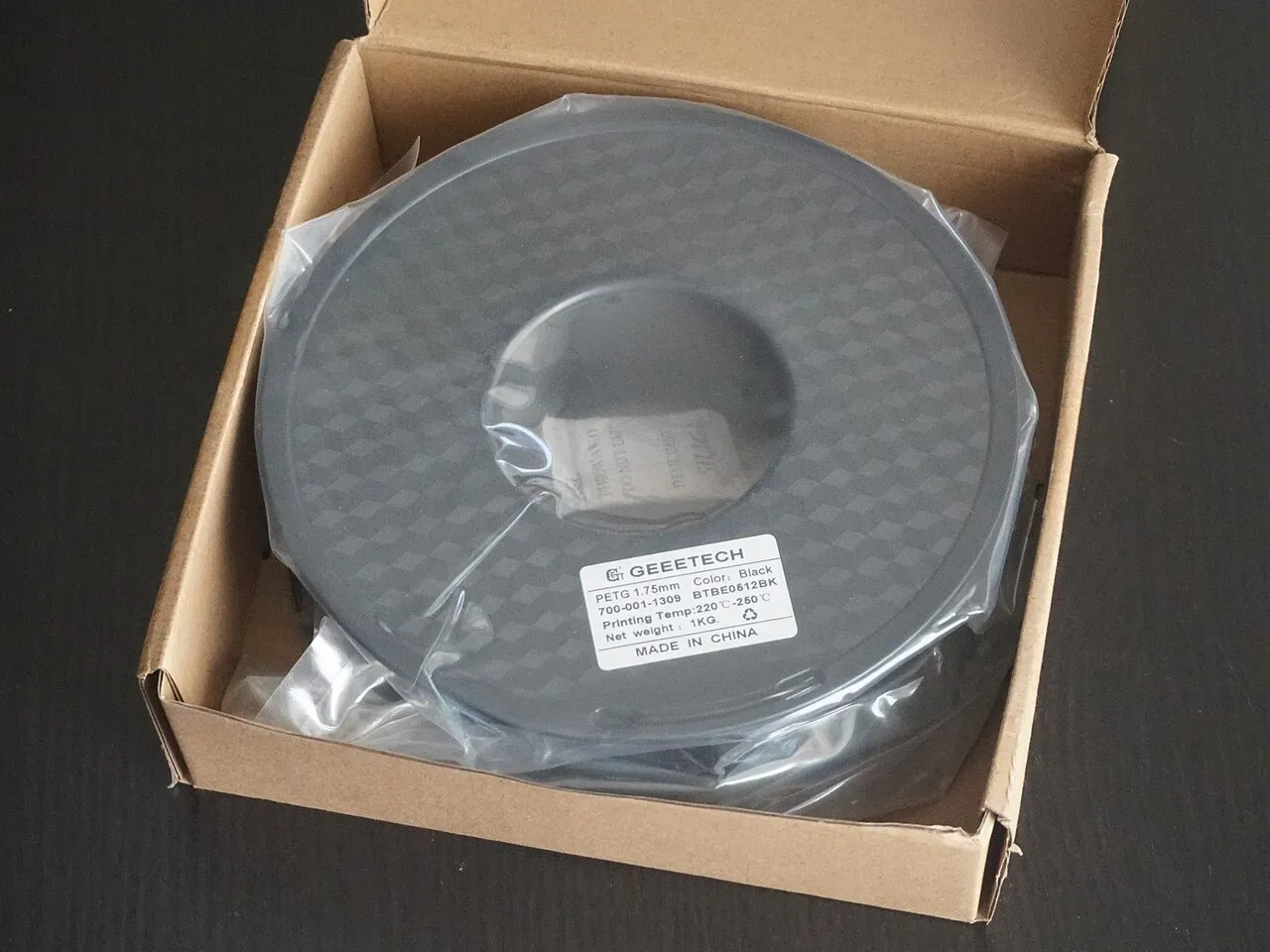 A 1 kg spool of PETG, sealed with desiccant.Photo: Suit ·CC BY-SA 4.0 ·Wikimedia Commons
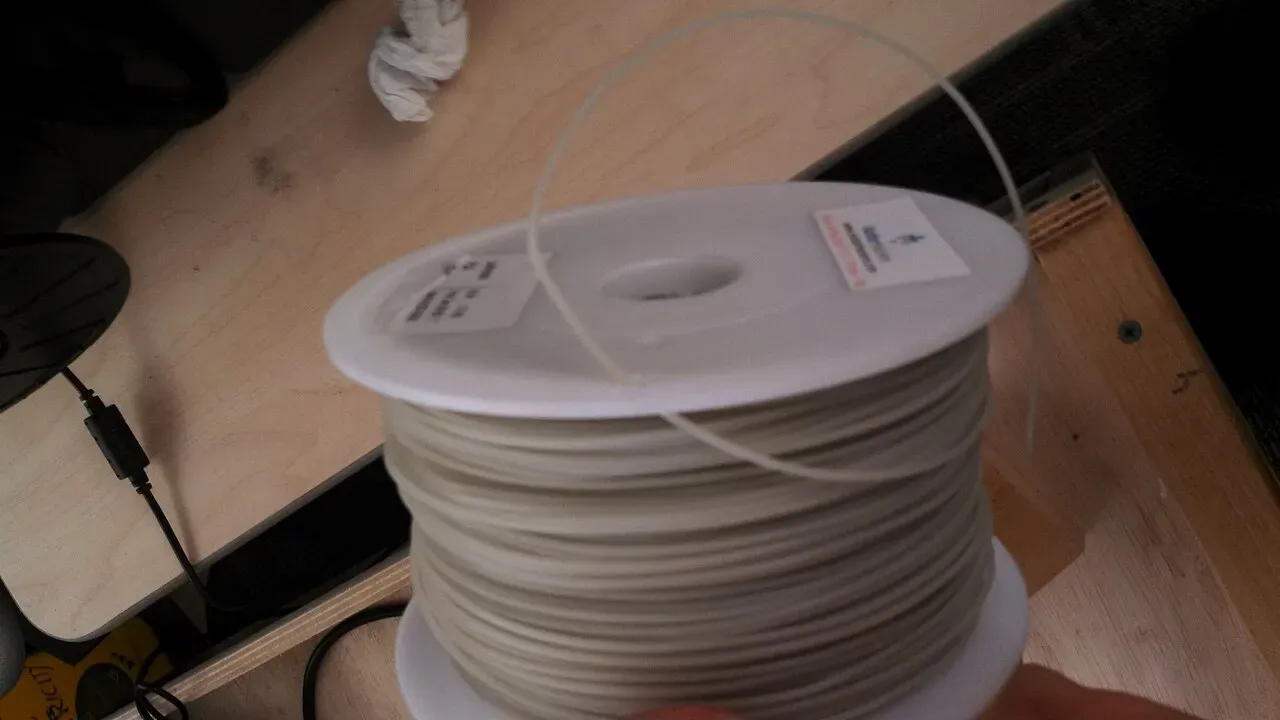 An open spool of PLA left out in the air.Photo: SuperBlobMonster ·CC BY-SA 3.0 ·Wikimedia Commons
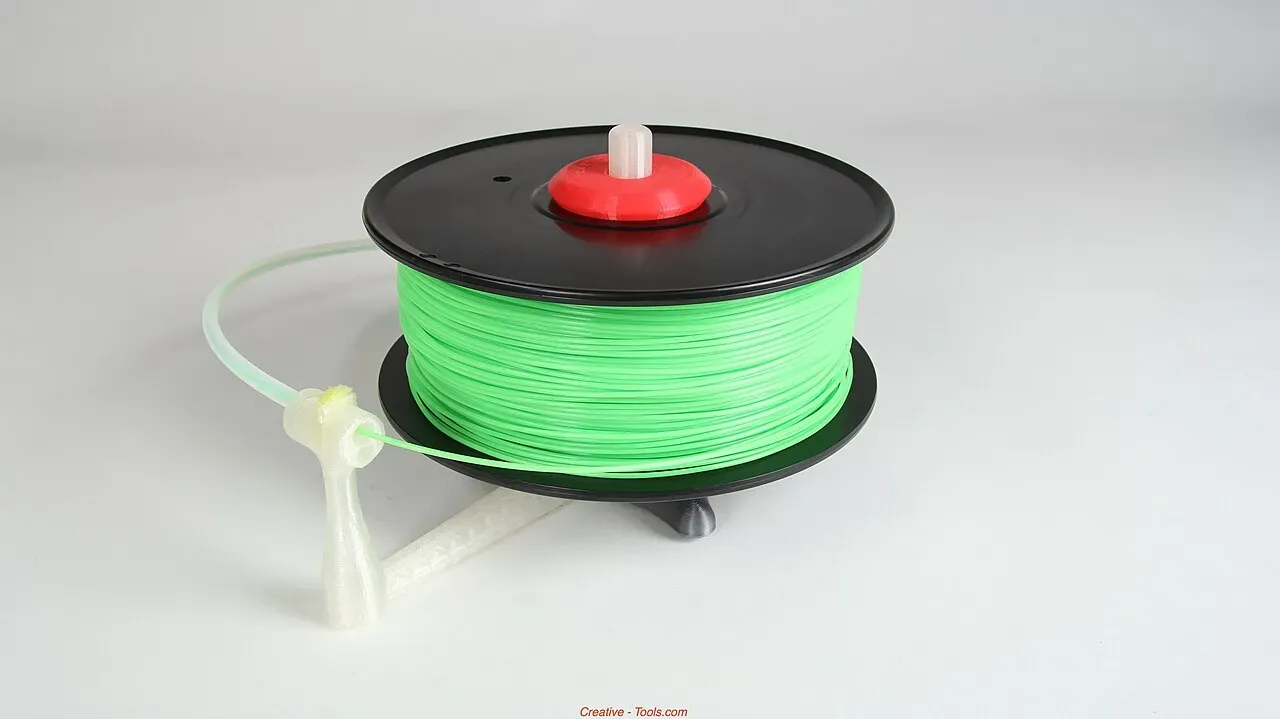 A simple spool holder lets the spool turn freely.Photo: Creative Tools ·CC BY 2.0 ·Wikimedia Commons
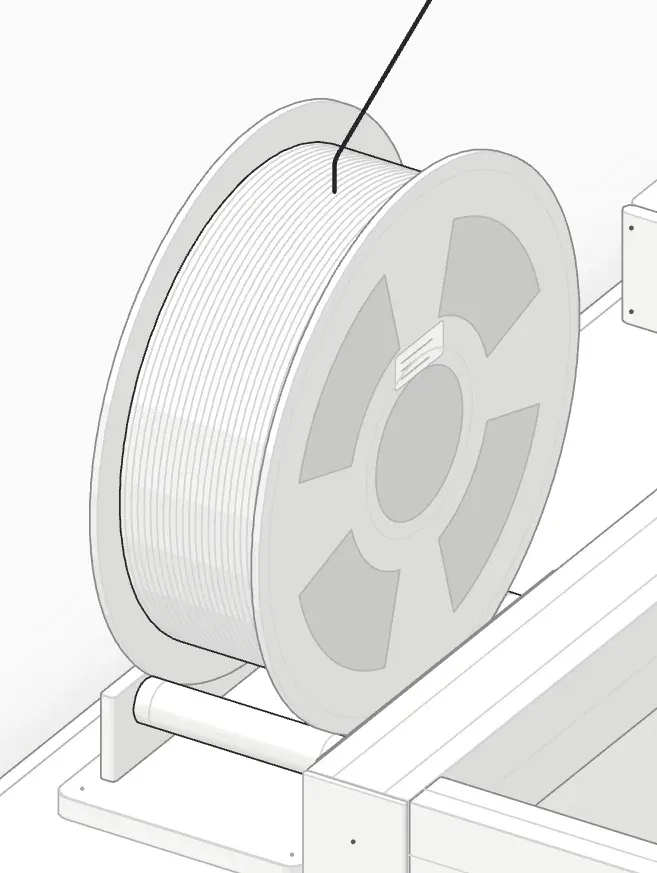 A 1 kg spool of 1.75 mm filament on a roller stand.
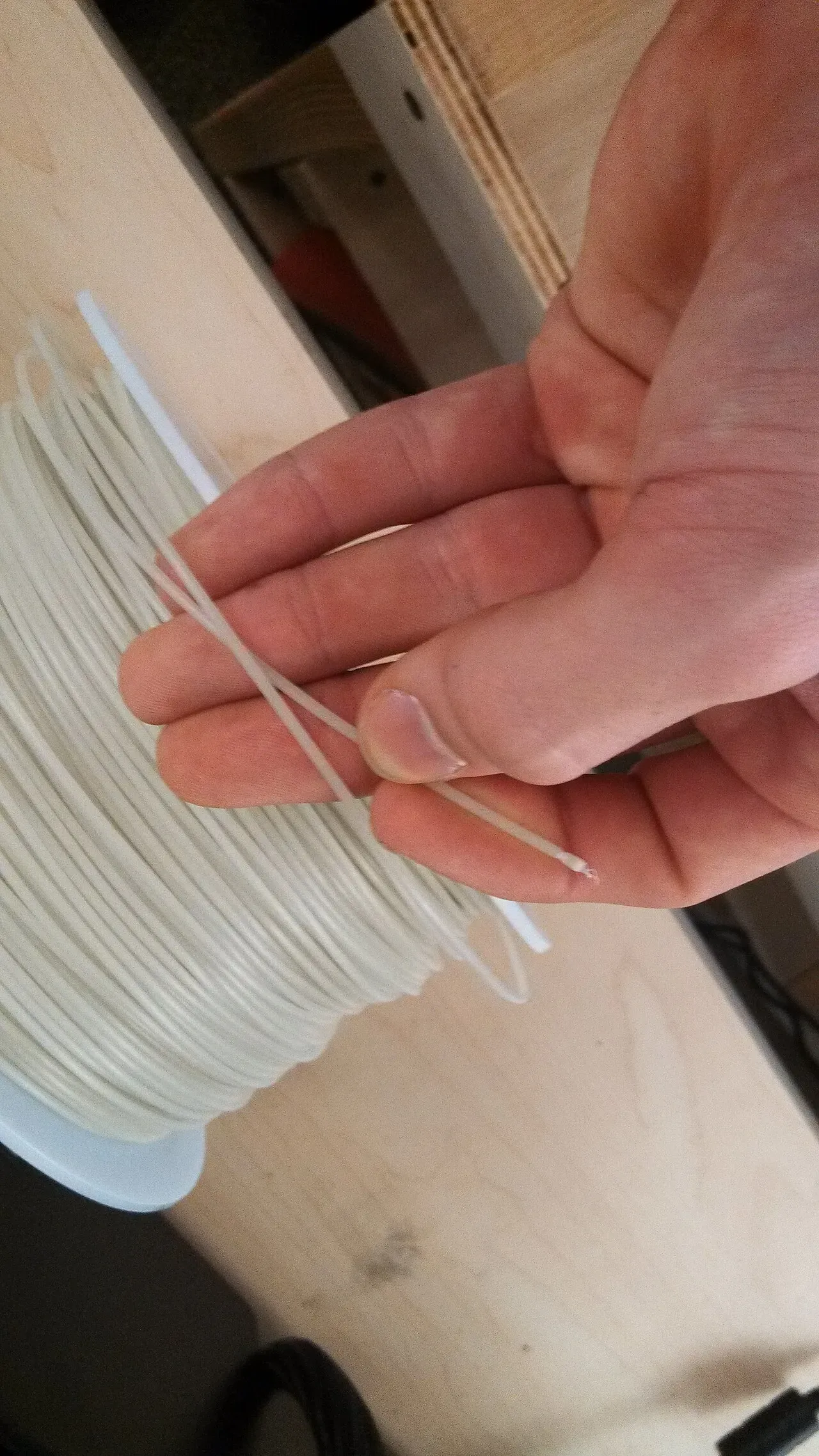 Crossed filament: a loop that can tangle and stop the extruder.Photo: SuperBlobMonster ·CC BY-SA 3.0 ·Wikimedia Commons
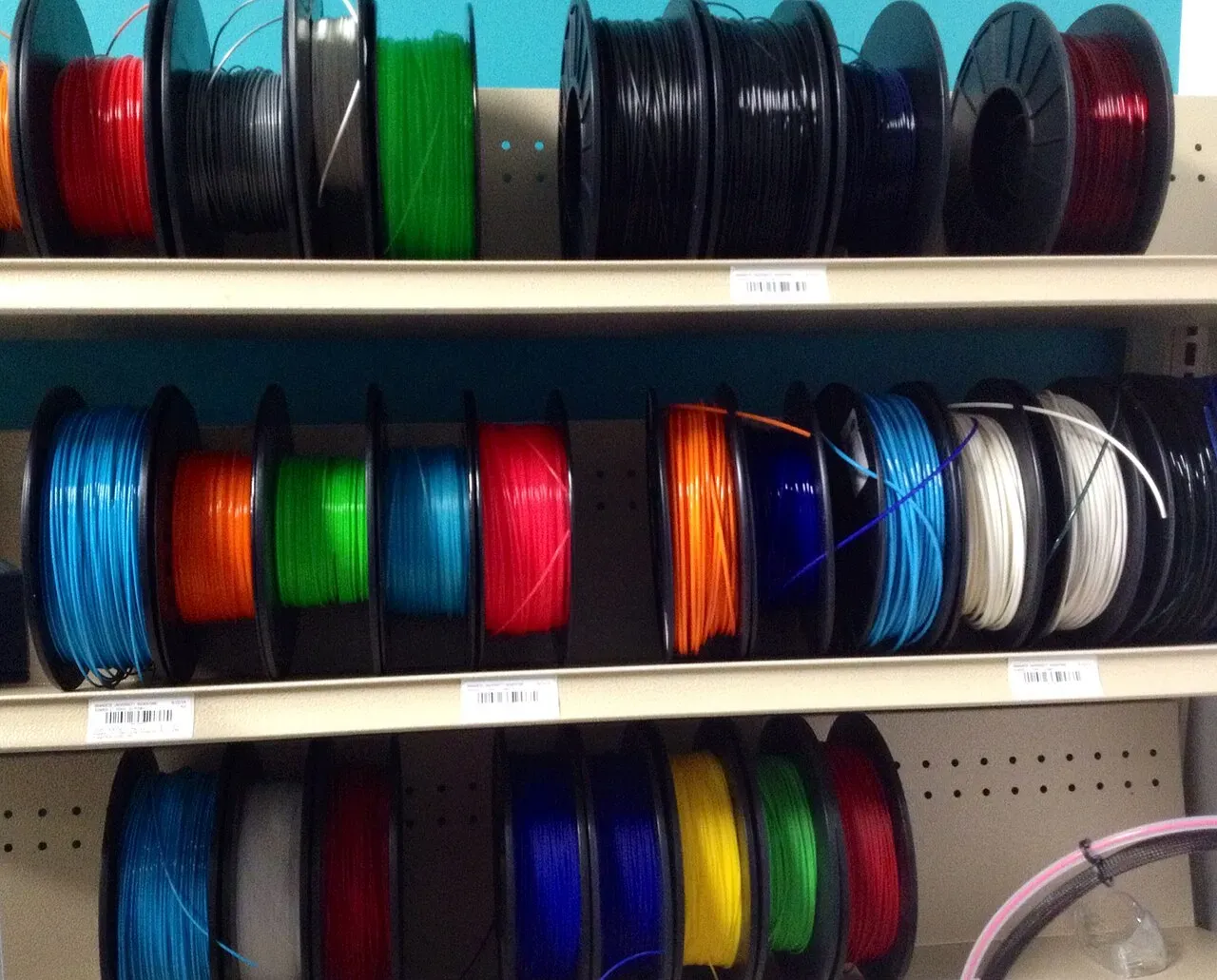 Filament comes in almost every colour.Photo: westonhighschool library ·CC BY-SA 2.0 ·Wikimedia Commons
Why storage matters
Most 3D printing plastics are hygroscopic: they pull water vapour out of the air and hold it inside the plastic. You can’t see it or wipe it off, and an open spool keeps soaking it up for as long as the air around it is damper than the filament.
Wet filament causes a familiar list of problems once it reaches the hot nozzle, because the water inside turns to steam:
- popping, crackling or hissing as it extrudes,
- sudden stringing and ooze on a spool that used to print cleanly,
- rough, fuzzy or bubbly surfaces, and glossy filaments losing their shine,
- weaker parts that split along layer lines,
- and with PLA, filament that turns brittle and snaps on the spool or in the feed tube.
Drying fixes all of that, but drying takes hours, uses power and isn’t kind to every spool if you do it often. Good storage means you dry rarely, and some spools never need it at all.11Drying temperatures and times for every common material are in our guide to how to dry filament. This guide picks up where that one stops: keeping a dry spool dry.
Moisture is the main reason to store filament carefully, but not the only one. Good storage also protects against:
- Heat. PLA starts to soften around 55–60 °C. A spool on a sunny windowsill, in a hot car or under a roof in summer can deform, and the turns can stick together.
- Sunlight. UV light fades colours and can weaken some plastics over time.
- Dust. Dust on the filament is carried straight into the nozzle, where it can build up into a partial clog.
- Tangles. A loose end that springs free lets the coils jump over each other. The crossed loop tightens as the printer pulls, and the print stops.
water 0.34 % · wet · 16 pops/s · ooze 0.34 mm³ per travel · line 91 % solid
- drag ↔ / ← → how wet the spool is: dry to left out in humid air
- D dry it in a filament dryer at 45–50 °C
- Home reset: a wet spool
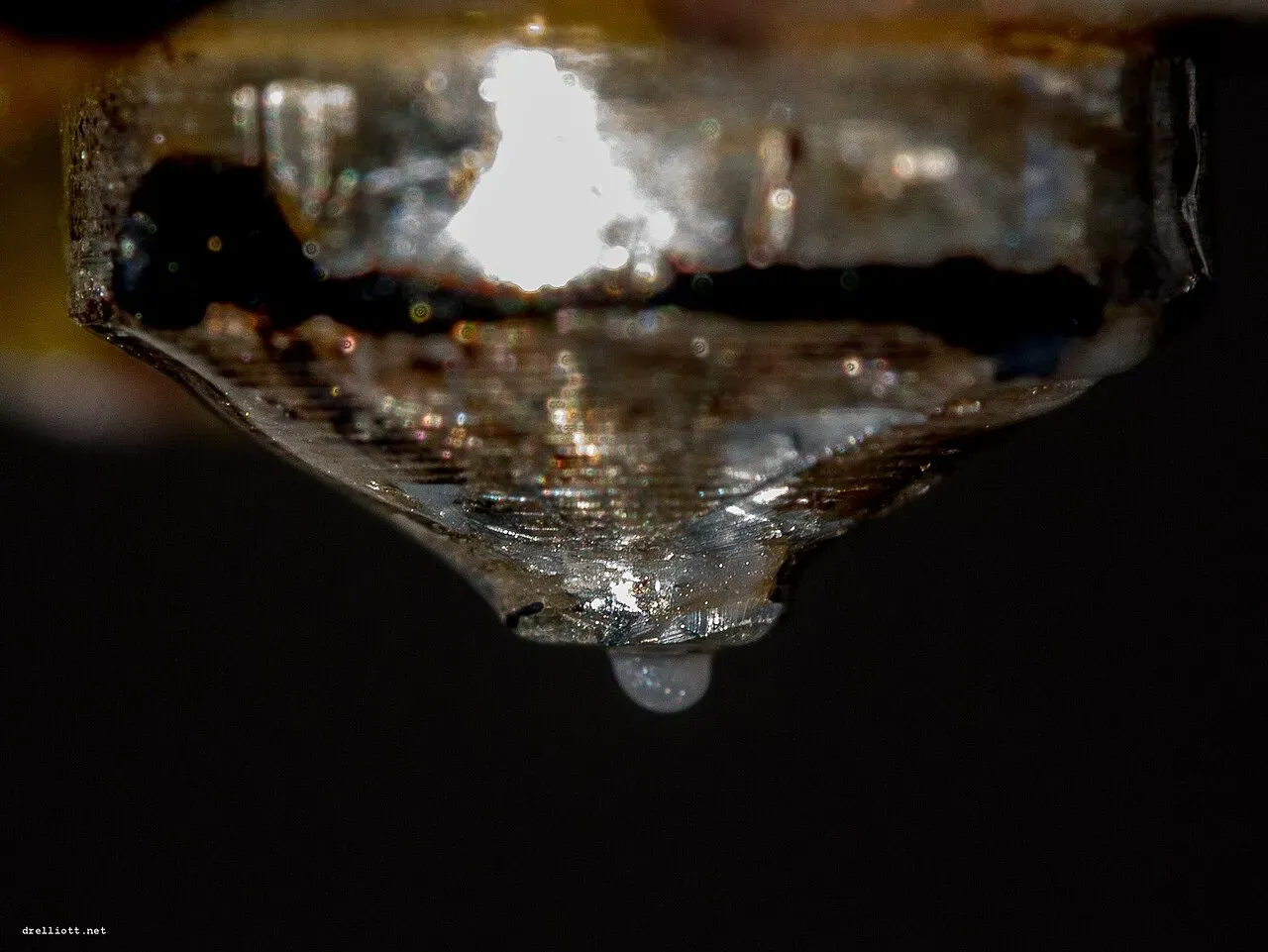 Ooze: a drop of molten plastic forming at the nozzle.Photo: David Elliott from UK ·CC BY 2.0 ·Wikimedia Commons
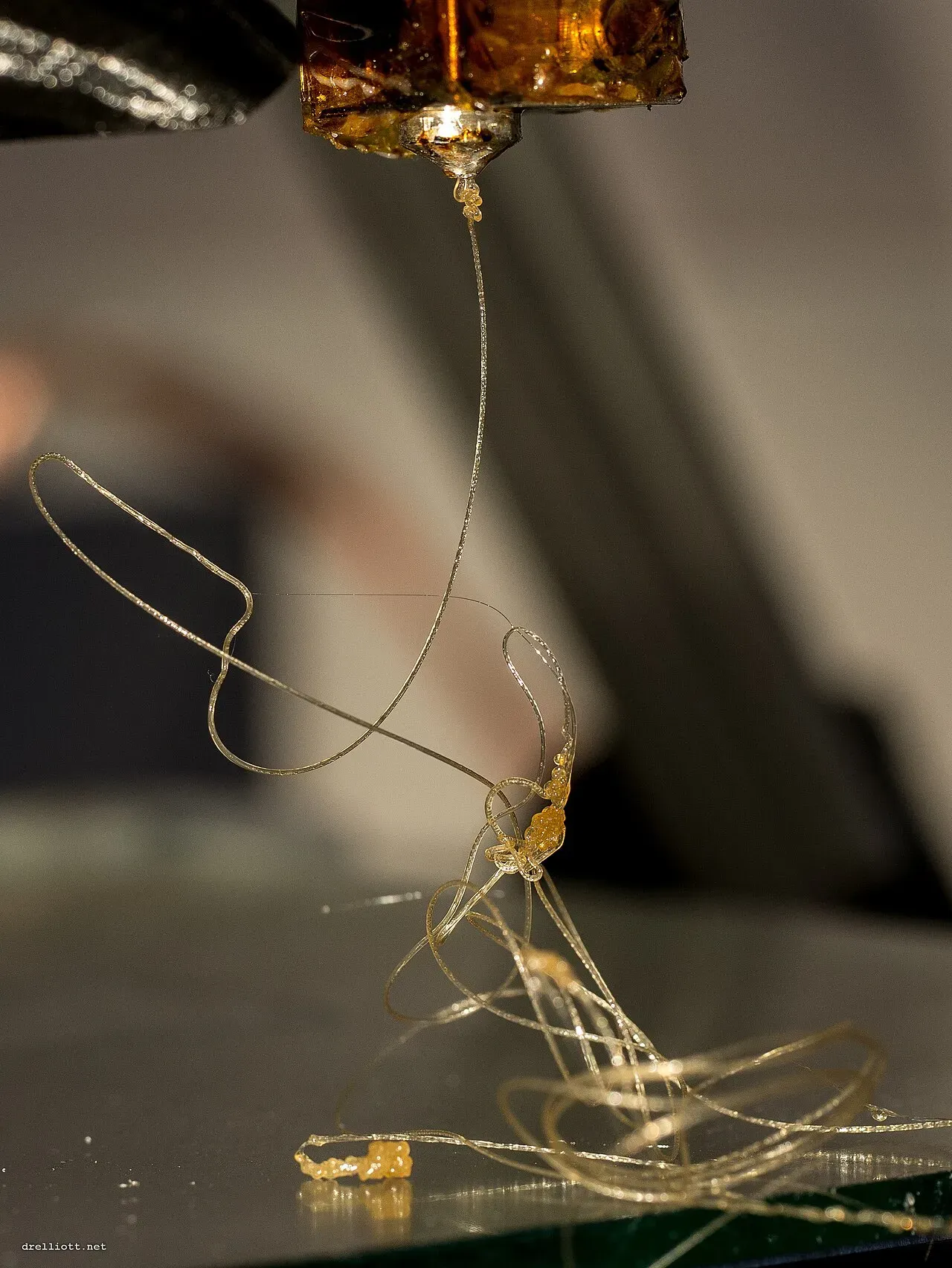 A thin strand pulled from the nozzle: where strings begin.Photo: David Elliott from UK ·CC BY 2.0 ·Wikimedia Commons
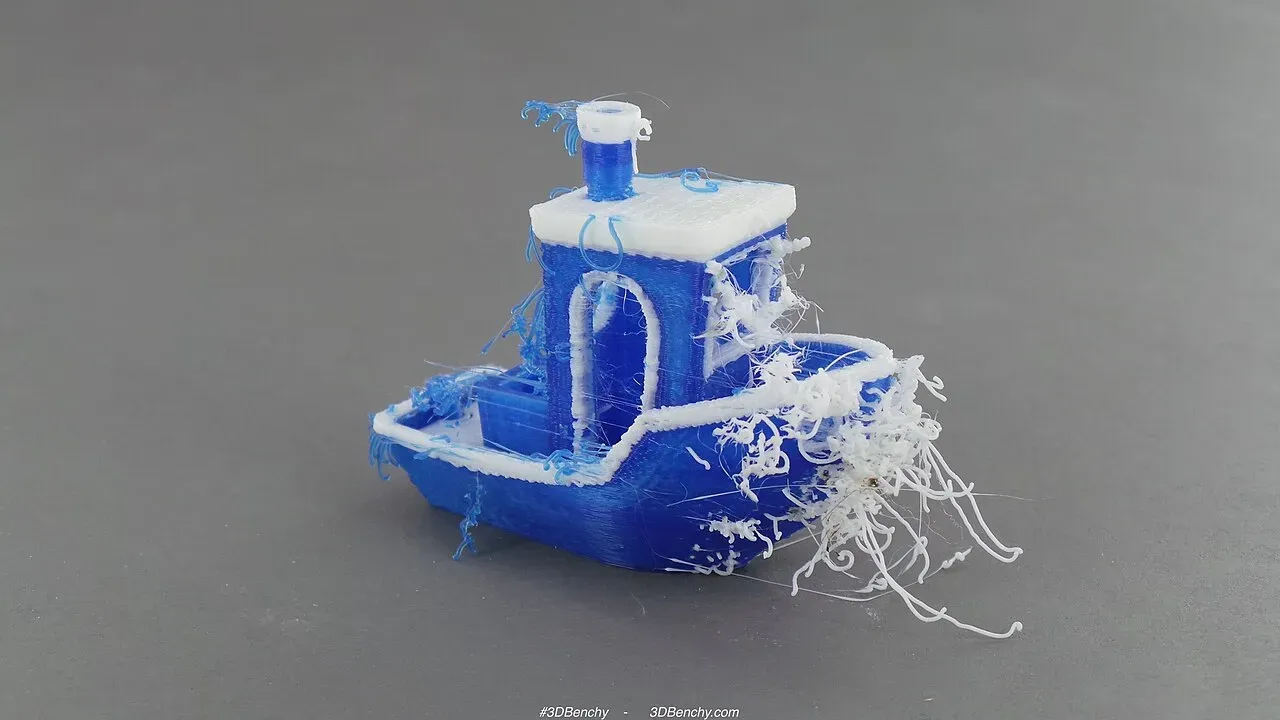 Stringing on a two-colour Benchy, where travel moves cross open air.Photo: 3DBenchy ·CC BY 2.0 ·Wikimedia Commons
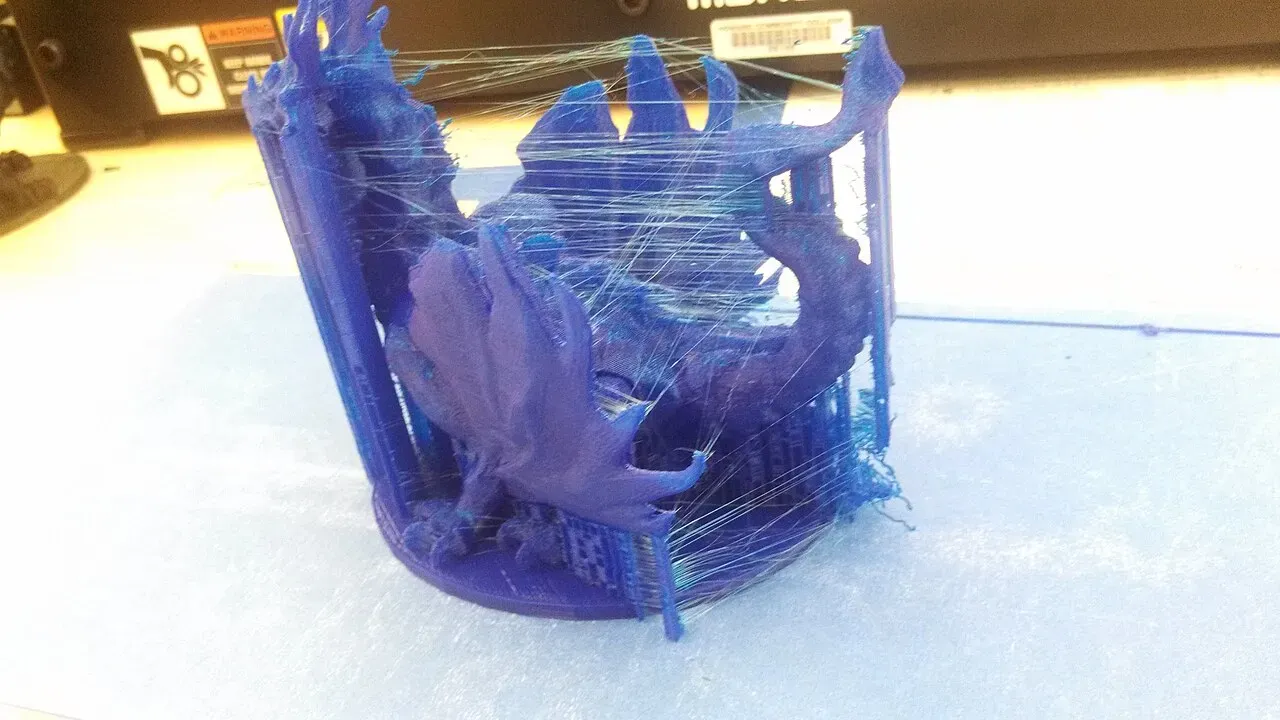 Close up: strings stretched between every travel move.Photo: SuperBlobMonster ·CC BY-SA 3.0 ·Wikimedia Commons
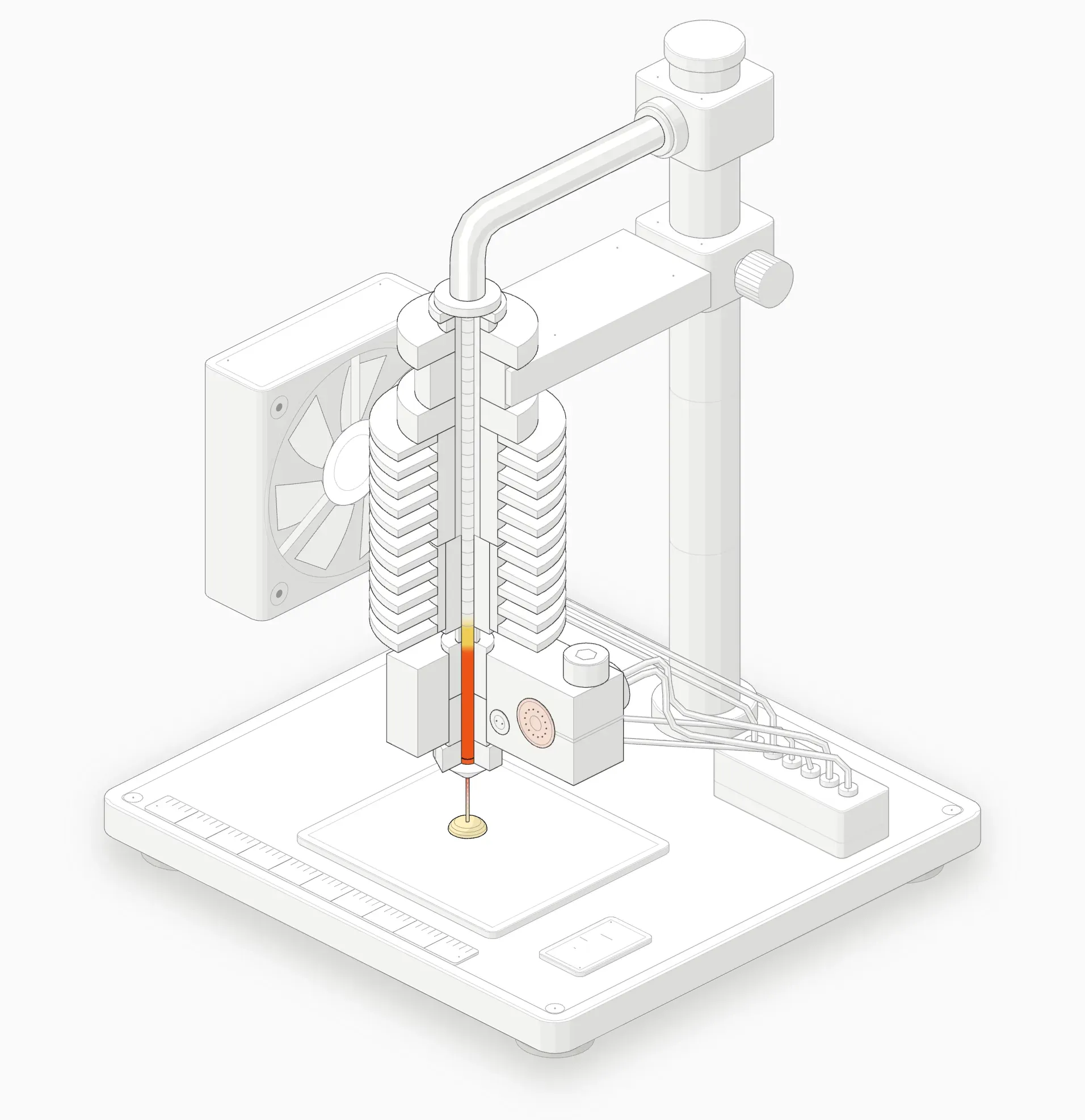
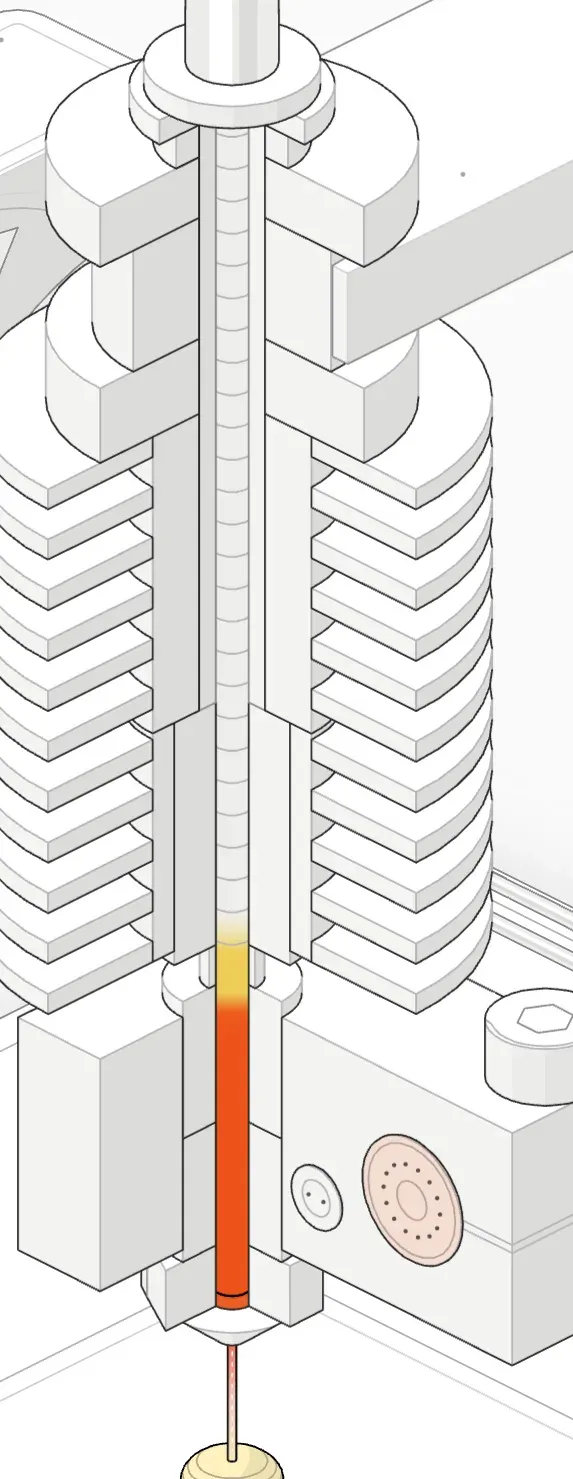 Solid filament above the heat break, molten filament in the heater block.
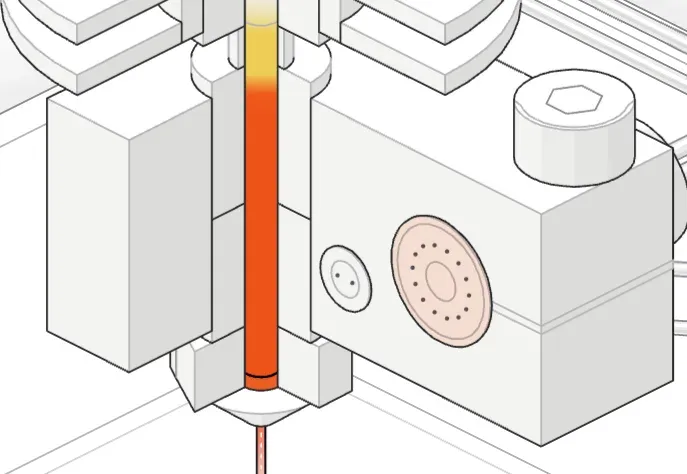 The heater block holds the heater cartridge and the thermistor.
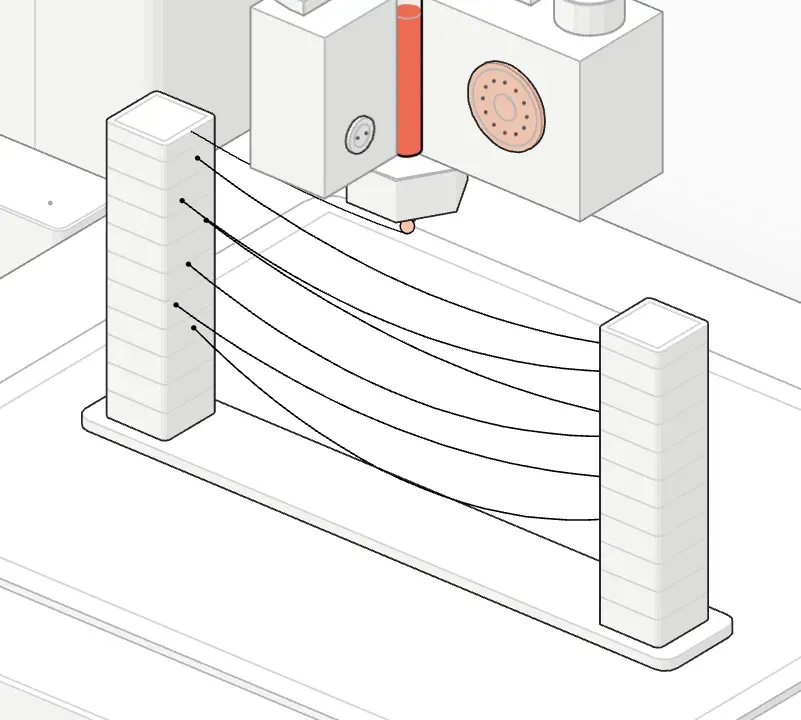 No retraction: many strings.
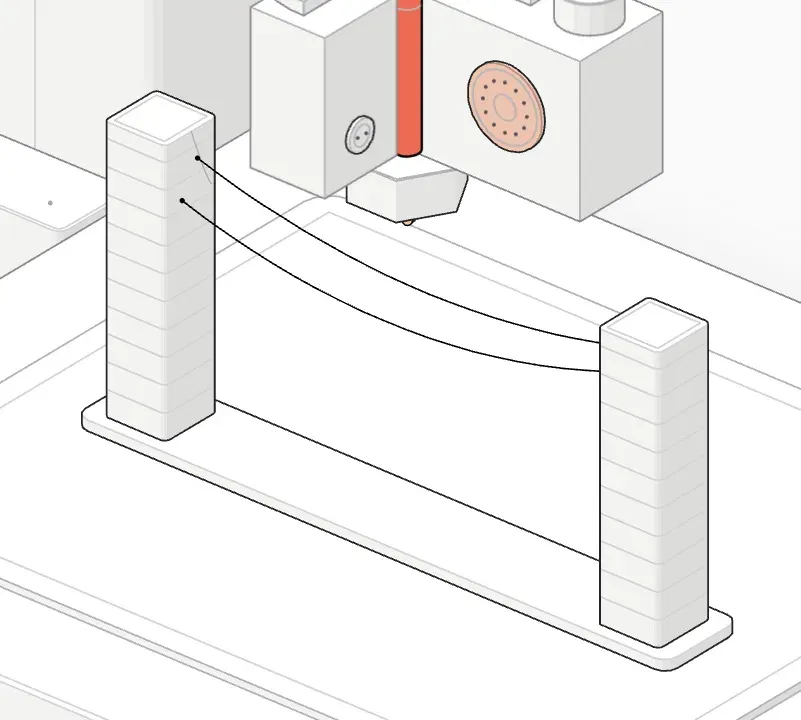 0.8 mm of retraction: a few strings.
Which filaments are most sensitive to moisture?
Every common filament absorbs some water, but how fast and how much it matters varies a lot. Roughly from thirstiest to least:
| Material | How sensitive | Store at (relative humidity) | Print from a dry box? |
|---|---|---|---|
| PVA and BVOH (dissolvable supports) | Extremely: can go soft and gummy in damp air | Below about 20%, sealed every time | Yes, always |
| Nylon (PA, PA6, PA12, PA-CF) | Very high: can print badly after a short time in a humid room | Below about 20%, lower is better | Yes, always |
| Polycarbonate (PC) | High | Below about 20% | Yes, for long prints |
| TPU and other flexibles | High | Below about 20% | Yes, for long prints |
| PETG | Moderate to high | Below about 20% | Helpful in humid rooms |
| ABS and ASA | Moderate | Below about 30% | Rarely needed |
| PLA, PLA+, silk and other PLA blends | Lowest, but it still gets wet over weeks or months | Below about 30% | Rarely needed |
| Carbon-fibre and glass-fibre composites | As the base plastic | As the base plastic | As the base plastic |
The humidity targets are common guidance in filament makers’ storage advice rather than hard limits. Prusa’s help pages, for example, single out polyamide (nylon), PVA and TPU as the filaments most often in need of drying, note that PLA changes much less when it takes up moisture, and suggest that if you can’t store everything sealed, you prioritise the most hygroscopic materials.22UltiMaker’s support pages give a wider band, storing most of its materials at about 10–30% relative humidity and keeping moisture-sensitive ones such as nylon, PVA and TPU below 50% at the very least. Below 20% for the sensitive group is the stricter, safer target.
In practice that means a simple rule of thumb for a small collection:
- One or two PLA spools on the go? A good zip bag or a box with some desiccant is plenty.
- Printing PETG or TPU? Give them a properly sealed box with a hygrometer, and keep it below 20%.
- Printing nylon, PC or PVA? Treat the spool as wet the moment it’s out of storage. Dry it before printing, print it from a dry box, and seal it again straight after.
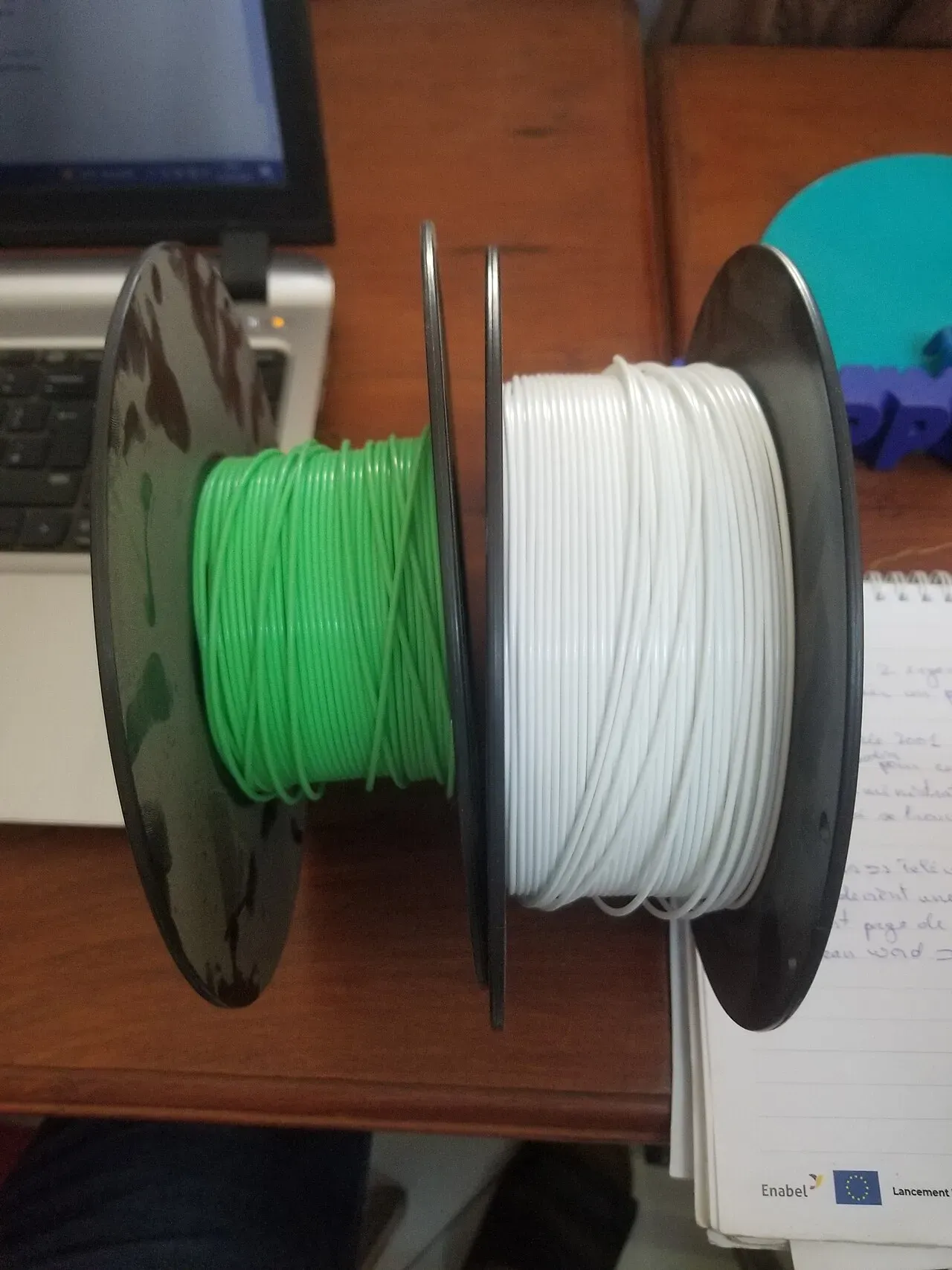 PLA: the beginner's filament.Photo: Richardspa ·CC0 ·Wikimedia Commons
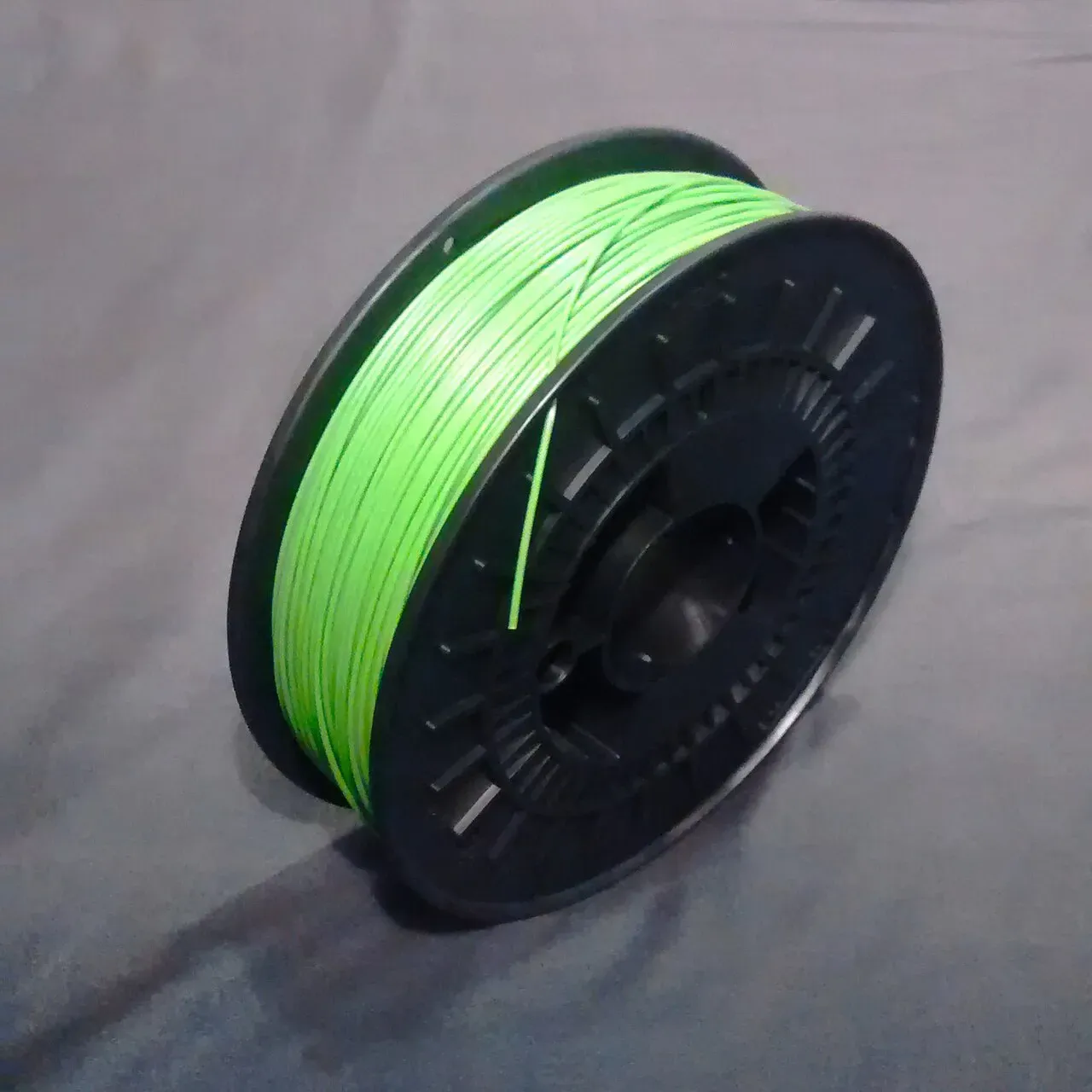 A spool of ABS.Photo: Tatár Lehel ·CC BY-SA 3.0 ·Wikimedia Commons
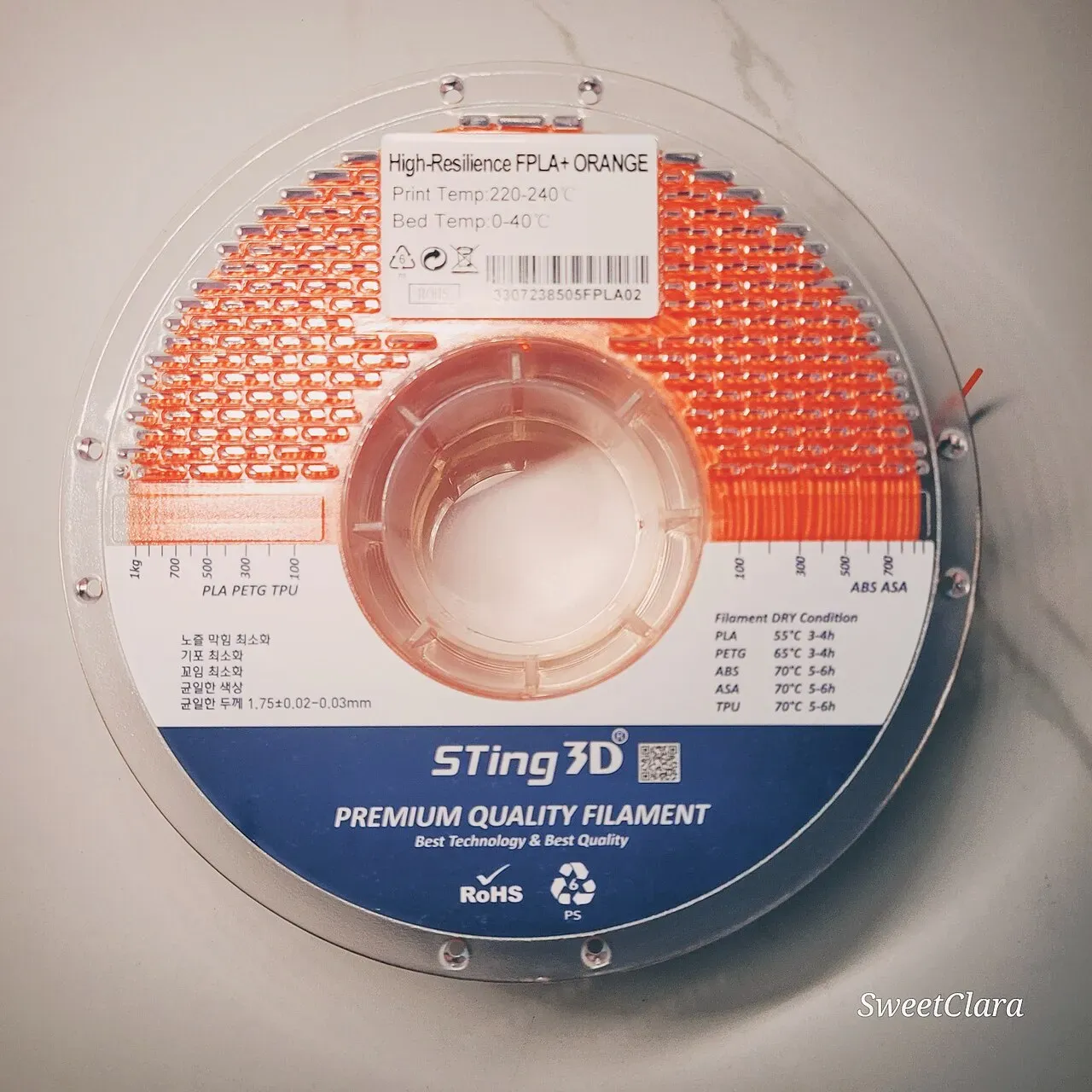 Flexible filament: label shows its print temperature.Photo: Sweetclara ·CC BY-SA 4.0 ·Wikimedia Commons
- A 1 kg spool of PETG, sealed with desiccant.Photo: Suit ·CC BY-SA 4.0 ·Wikimedia Commons
For what each material is good at and what it needs from your printer, see our 3D printing filament guide.
Humidity targets explained
What “relative humidity” means
A hygrometer shows relative humidity (RH): how much water vapour the air holds, as a percentage of the most it could hold at that temperature. 100% is air that can’t take any more; 0% is perfectly dry air.
Filament slowly settles towards a balance with the air around it. In damp air it takes water in; in very dry air it gives a little back. That’s why the number on the hygrometer matters more than how long a spool has been open: a spool in a sealed box at 15% stays dry for a long time, and one on a shelf at 55% doesn’t.
How damp is a normal room?
Drier than you’d think for comfort, and much damper than filament likes. The US Environmental Protection Agency recommends keeping indoor humidity below 60%, ideally between 30 and 50%, for comfort and to prevent mould. A comfortable room at 40–50% is still two or three times the humidity a PETG or nylon spool should sit in. Kitchens, bathrooms, basements and garages are often higher still.
Temperature changes the reading
Relative humidity depends on temperature. Cool down a sealed box and its RH goes up, even though no water got in, because cooler air can hold less vapour. Warm it up and the RH goes down. So:
- A box that has just come out of a warm dryer reads low at first and climbs as it cools to room temperature. That’s normal; read it again a few hours later.
- Read the hygrometer at room temperature when you’re judging whether the desiccant needs recharging.
- Don’t store boxes where the temperature swings a lot, such as a garage that’s warm by day and cold by night.
Storage options compared
There’s no single right container. The best choice depends on how many spools you have, which materials, and whether you print from storage.
| Option | How well it keeps filament dry | Cost | Good for | Watch out for |
|---|---|---|---|---|
| Original resealable bag + desiccant | Fair, if the seal still closes | Free | A few PLA spools | Many bags don’t reseal well after a few openings |
| Zip bag + desiccant | Fair to good | Very low | PLA and ABS, short-term PETG | Thin bags tear on spool edges and let air through slowly |
| Vacuum storage bag + desiccant | Good while it holds the vacuum | Low | Long-term storage, lots of spools in little space | Valves and seams can leak; check that it stays tight |
| Airtight box with a gasket + desiccant | Good to very good | Low to medium | One to six spools, any material | Clip-lid boxes without a gasket aren’t airtight |
| Dry box with a feed outlet | Good, and you can print from it | Low (DIY) to medium | Nylon, TPU, PETG, PVA while printing | Every hole is a leak path; seal the fitting |
| Heated filament dryer | Very good while it runs | Medium | Drying and printing the thirstiest materials | Uses power; holds one or two spools |
| Multi-material unit with desiccant bays | Fair to good, depends on the desiccant | High (part of the printer) | Spools you use every week | Desiccant needs replacing or recharging regularly |
| Electronic dry cabinet | Very good | High | Large collections | Expensive; check the lowest humidity it can hold |
- A 1 kg spool of PETG, sealed with desiccant.Photo: Suit ·CC BY-SA 4.0 ·Wikimedia Commons
 A screw-top box: threads print well at 0.2 mm layers.Photo: syvwlch ·CC BY 2.0 ·Wikimedia Commons
- A simple spool holder lets the spool turn freely.Photo: Creative Tools ·CC BY 2.0 ·Wikimedia Commons
- A 1 kg spool of 1.75 mm filament on a roller stand.
Bags: the cheap, flexible option
Bags are the simplest way to start. Keep the bag a new spool came in: many are resealable, and the rest can be folded and closed with a clip. Thick freezer-style zip bags work too.
To use a bag well:
- Put a sachet or bag of desiccant in with the spool. The small packet that came with the spool is a start, but it was sized for a sealed factory bag, not one you open every week.
- Squeeze out as much air as you can before closing it. Less air means less water vapour trapped inside with the spool.
- Close the seal fully, running your fingers along it twice.
- Store bagged spools in a box or drawer, away from sharp edges and sunlight.
Bags slowly let moisture through their walls and seals, so they’re best for PLA, for ABS, and for PETG you’ll use within a few weeks.
Vacuum bags: compact and good for the long term
Vacuum storage bags (the kind sold for clothes or food, with a one-way valve and a hand pump) pull most of the air out and squeeze the bag tight around the spool. Many makers use them for long-term storage, and Prusa’s help pages mention vacuum bags with desiccant inside as a popular way to keep filament dry.
How to vacuum-bag a spool:
- Dry the spool first if it’s been out of storage for a while. A vacuum bag keeps water out; it doesn’t pull water out of the plastic.
- Add desiccant inside the bag, in a sachet or a breathable pouch.
- Clip the free end of the filament into the spool’s edge holes so it can’t spring loose.
- Wrap or pad the spool’s rim if it has sharp edges, or put the spool in its cardboard box first, so it can’t puncture the bag.
- Seal the zip, then pump the air out through the valve until the bag is tight.
- Check it the next day. If the bag has gone slack, air is getting in through the valve or a seam. Re-seal it, or use a different bag.
Vacuum bags are best for spools you won’t touch for weeks or months. For spools you use every few days, pumping the bag down each time gets tedious, and a box is easier.
Airtight boxes: the everyday workhorse
A plastic food storage box, cereal container or storage tub with a rubber or silicone gasket in the lid is the most popular way to store spools you use often. Small boxes hold one spool; large clip-lid tubs with a seal hold several.
What to look for:
- A gasket. A lid that just snaps or clips on without a seal isn’t airtight, however tight it feels.
- Enough room for desiccant and a hygrometer next to the spools.
- Clear sides, so you can see the colours and the hygrometer without opening the lid.
- A size that fits your spools. Measure them: standard 1 kg spools vary in width and diameter between brands.
Every time you open the lid, room air rushes in and the desiccant has to soak up that moisture again. Group spools so the ones you use most share a box, and keep rarely used ones in a separate box or a vacuum bag.
Dry boxes you can print from
A dry box is an airtight box with a way for the filament to leave it while the spool stays sealed inside. You can buy them, or build one:
- Start with an airtight box that has a gasket and fits your spool with a little room to spare.
- Fit a spool holder or rollers inside. Printed roller holders on small ball bearings let the spool turn freely, so the extruder doesn’t have to drag it.
- Drill one hole for the filament outlet and fit a push-fit PTFE tube coupling through it. Seal around the fitting with a gasket or a ring of silicone so air can’t leak around it.
- Run a PTFE tube from the outlet to your printer’s extruder. Keep it reasonably short and without tight bends.
- Add desiccant and a hygrometer inside.
- Load the spool, feed the filament through the tube, close the lid and print.
A heated filament dryer that lets you feed filament out while it runs does the same job, and keeps drying the spool as it prints. That’s the best option for nylon and PVA, and a good one for TPU and PETG on long prints.
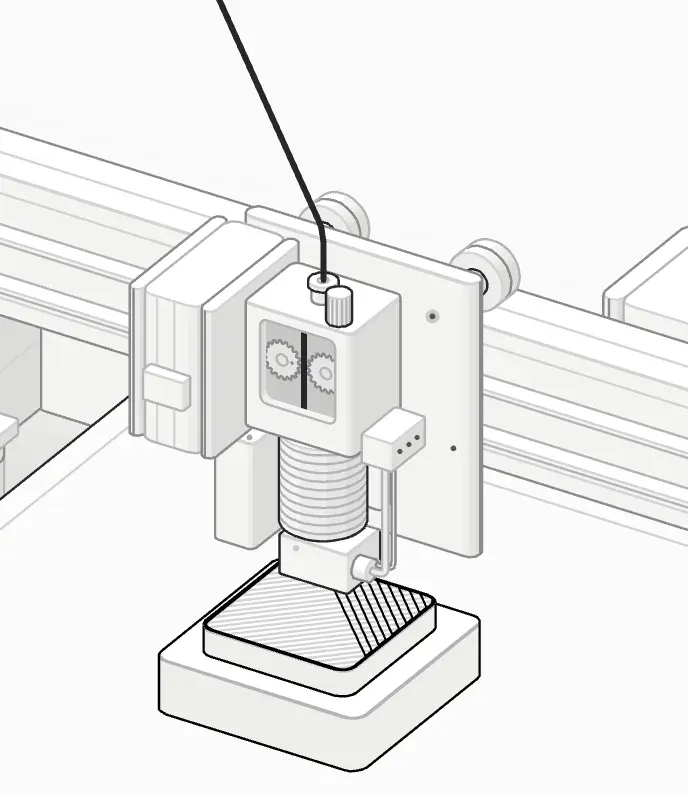 The print head: extruder on top, finned heatsink, heater block and nozzle.
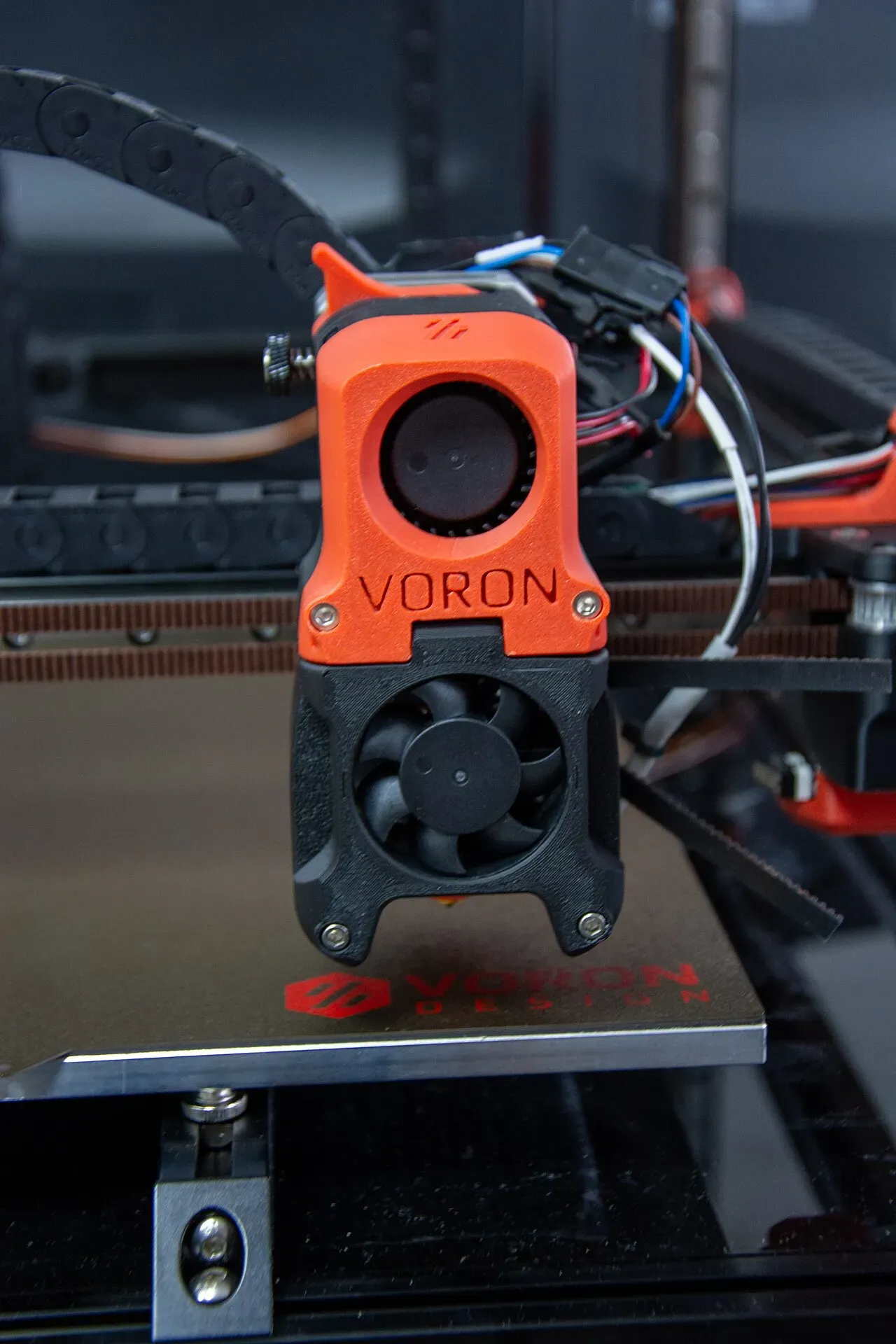 A modern toolhead: extruder, hotend and fans in one housing.Photo: disinterpreter ·CC BY-SA 2.0 ·Wikimedia Commons
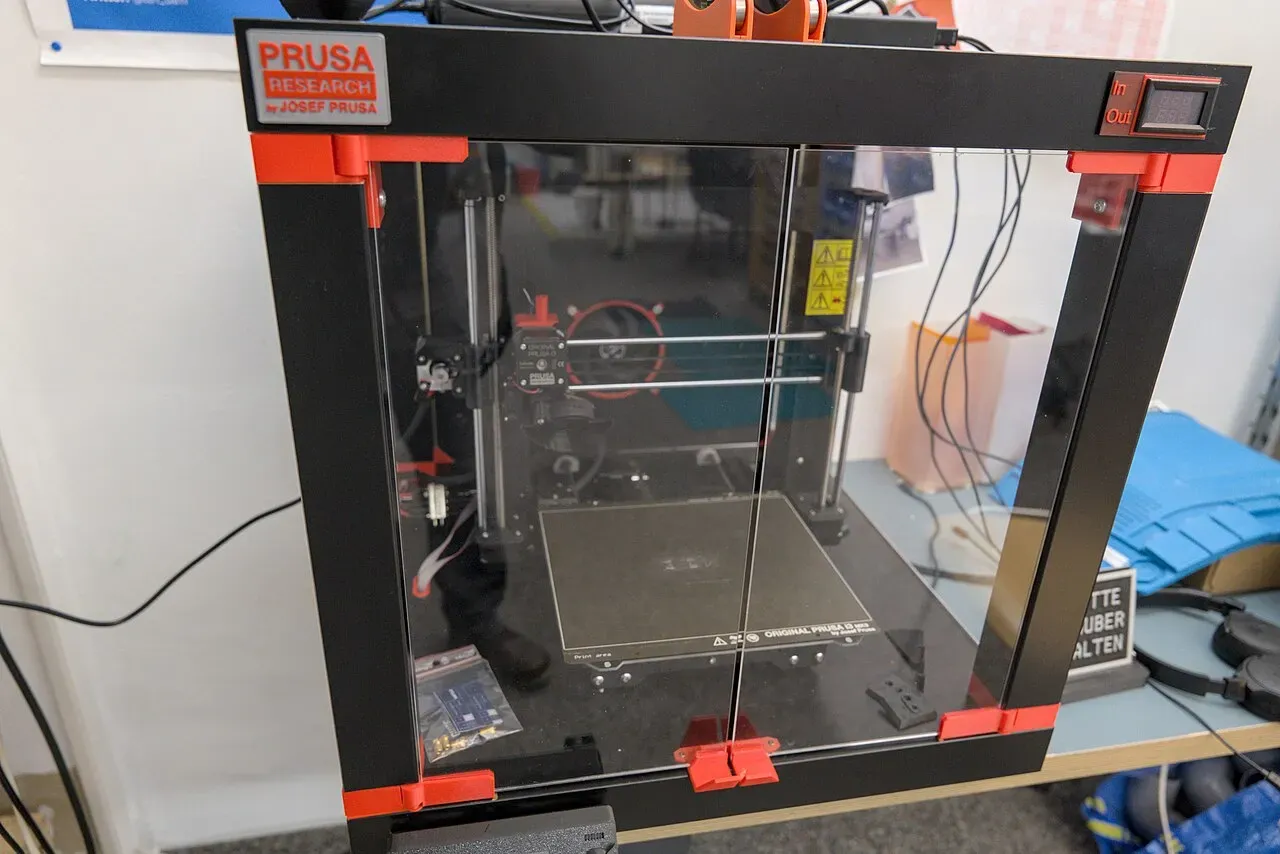 An enclosure keeps heat in for ABS and ASA.Photo: -stk ·CC BY-SA 4.0 ·Wikimedia Commons
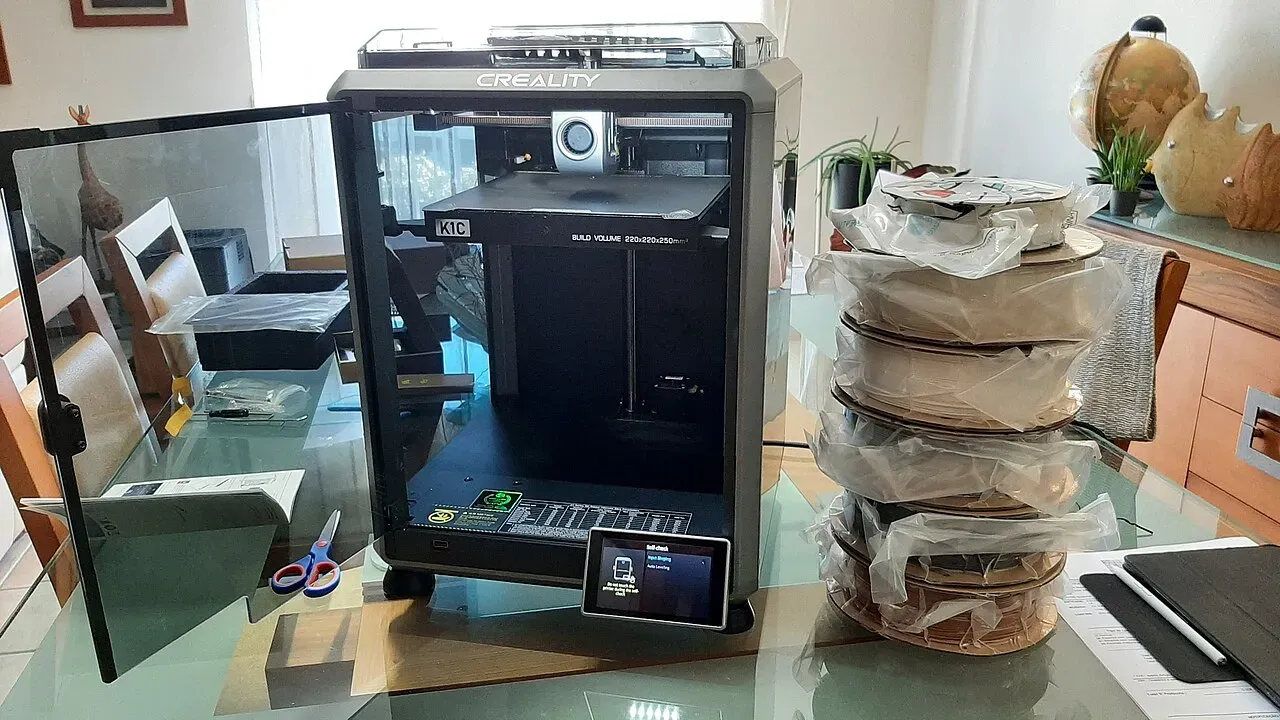 An enclosed CoreXY printer on a home desk.Photo: Mortymore ·CC BY 2.0 ·Wikimedia Commons
Multi-material units and printer storage
Many printers now come with an automatic material system that holds several spools in a closed unit, often with a bay for desiccant. These keep spools much drier than an open shelf, but only while the desiccant is fresh, and they’re opened every time you swap a spool. Follow the maker’s advice on replacing or recharging the desiccant. Bambu Lab’s wiki, for example, recommends storing dried filament in a sealed box or in its AMS with desiccant, and checking the desiccant first when the AMS humidity reading looks wrong.
If you print nylon or PVA, don’t rely on a multi-material unit alone: dry the spool before the print and seal it away after.
Dry cabinets
Electronic dry cabinets, sold for cameras and electronics, hold a set low humidity without any desiccant to recharge. They suit large collections, but they’re expensive. Check the lowest humidity a cabinet can actually hold before buying one for nylon; some are designed for camera storage at around 30–40%, which is too damp for the most sensitive filaments.
Desiccant: choosing it, using it, recharging it
Desiccant is what actually takes the water out of the air in your box. The container only stops more water getting in.
Types of desiccant
| Type | How it looks | Strengths | Weaknesses |
|---|---|---|---|
| Indicating silica gel (orange type) | Orange beads that turn green or pale as they fill | Shows when it’s used up; rechargeable at home; widely available | Holds less water at very low humidity than molecular sieve |
| Indicating silica gel (blue type) | Blue beads that turn pink | Shows when it’s used up | Usually coloured with cobalt chloride, a hazardous chemical; prefer the cobalt-free orange type |
| Plain (non-indicating) silica gel | Clear or white beads, often in sachets | Cheap | You can’t see when it’s full; pair it with a hygrometer or mix in some indicating beads |
| Molecular sieve | Small beige or grey beads | Pulls humidity lower and holds it there longer | Needs much more heat to recharge; no colour change |
| Clay desiccant | Grey granules in sachets | Cheap, common in packaging | Lower capacity; no colour change |
| Calcium chloride “damp traps” | Tubs of white crystals that turn into liquid | Absorb a lot of water in damp rooms | Make a salty liquid that can spill onto filament and electronics; not for filament boxes |
For most people, orange indicating silica gel is the right choice: it’s cheap, safe to handle, easy to recharge and tells you when it needs it. Silica gel works best at moderate humidity; once the box is already quite dry, a little extra water raises the reading quickly. If you want a nylon box to sit at 10% or below, many makers mix in or switch to molecular sieve, which holds very low humidity better but takes much more heat to recharge.33Users who have compared the two in filament boxes report molecular sieve reaching lower readings faster than silica gel. That’s hobbyist experience rather than a controlled test, but it matches how the two materials are described by desiccant makers.
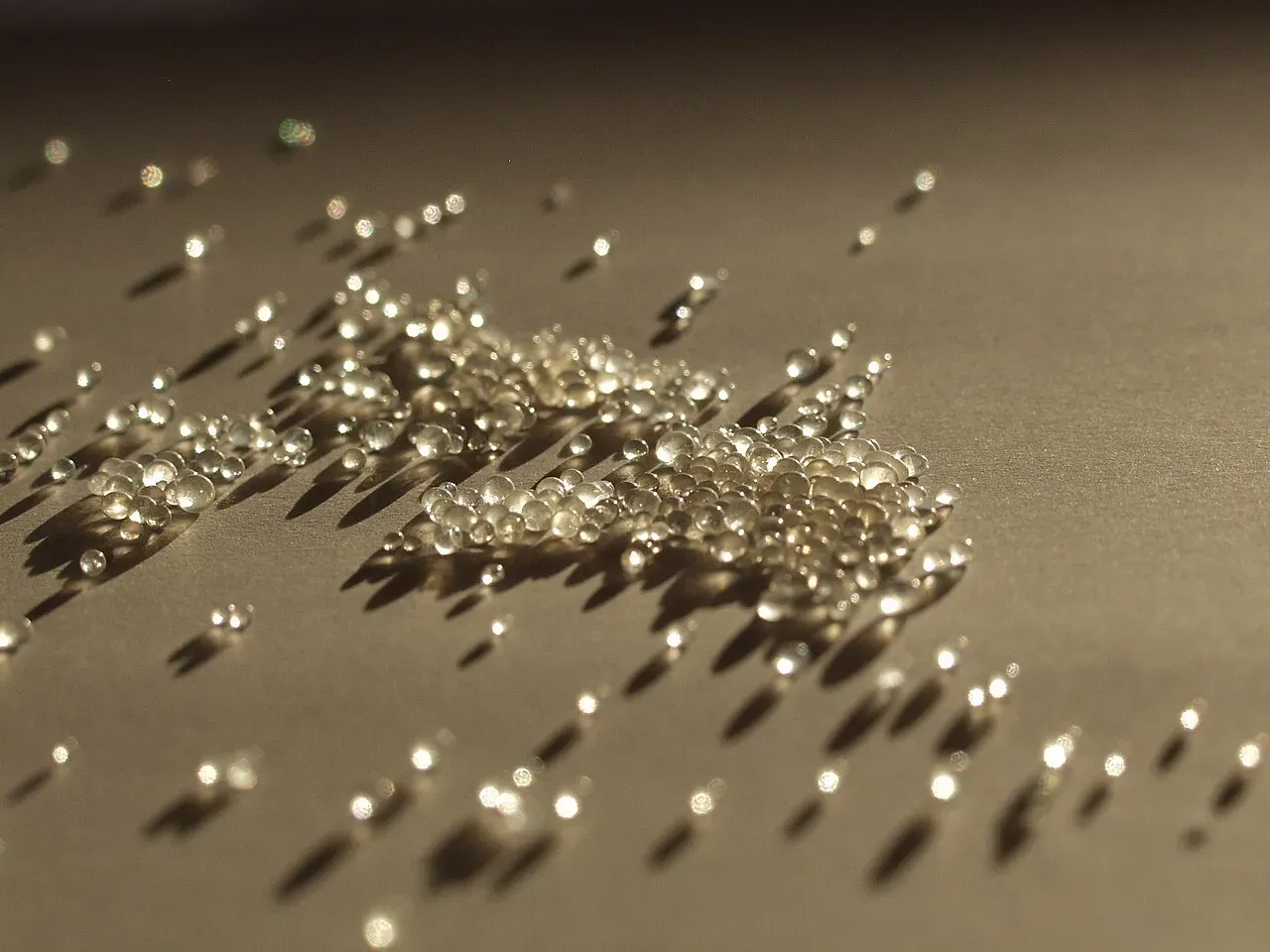 Loose silica gel beads. Each one is full of tiny pores that hold water vapour from the air.Photo: Wiebew ·CC BY-SA 3.0 ·Wikimedia Commons
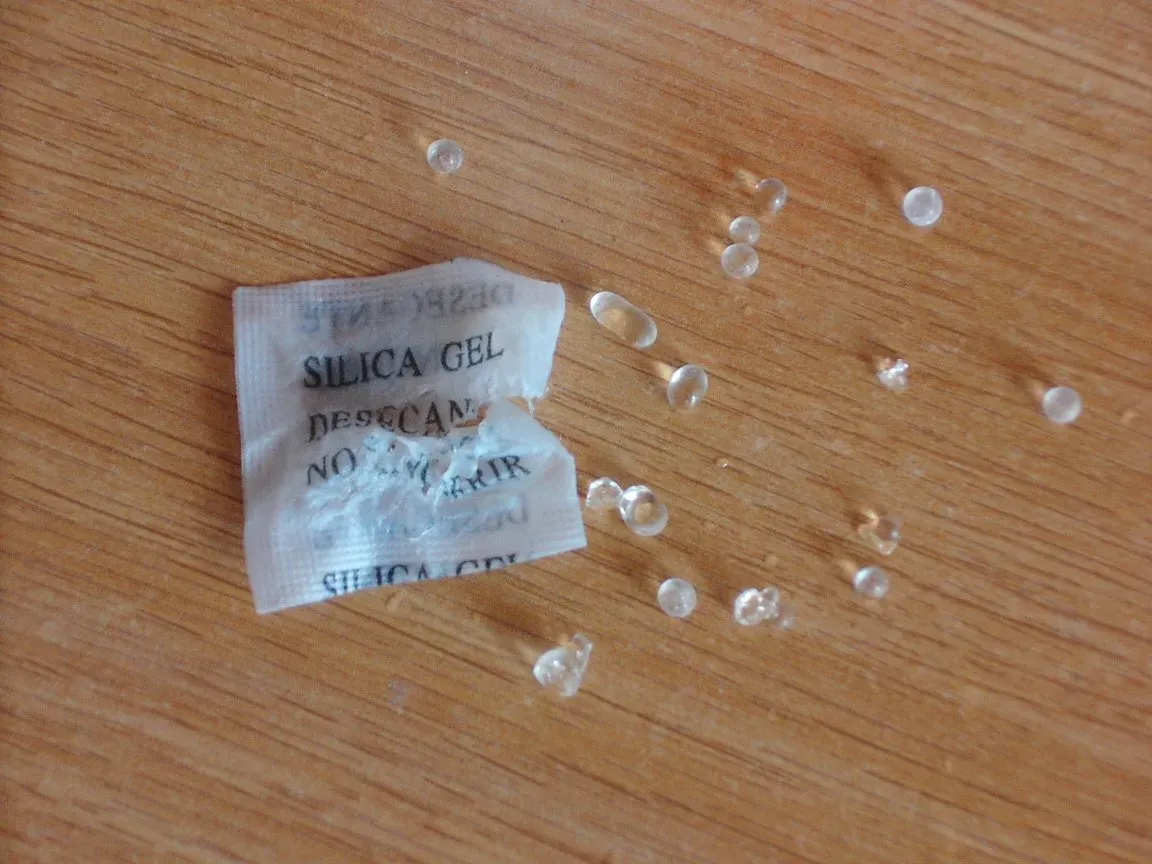 A silica gel sachet like the one in a new spool's bag. Small packets fill up quickly in a big box.Photo: Daniel Clemente ·Public domain ·Wikimedia Commons
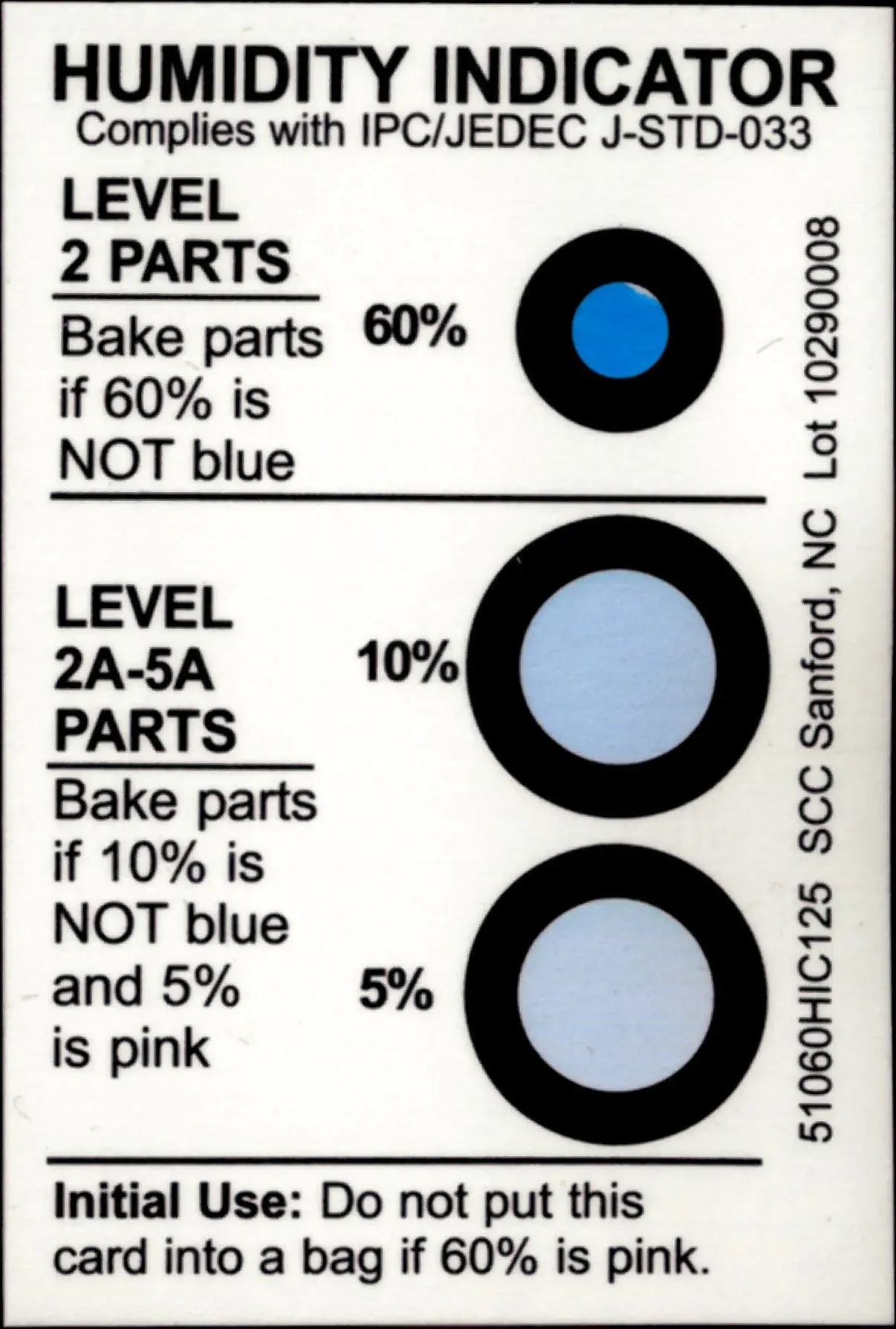 A humidity indicator card from a sealed bag: each spot changes colour when the air passes its humidity level.Photo: Pemu ·CC0 ·Wikimedia Commons
How to use it
- Use plenty. A small sachet in a big box fills up in days. More desiccant lasts longer between recharges. Loose beads in a breathable pouch or a printed container with holes are cheaper than sachets.
- Keep it out of the filament path. Beads must never get loose where they can reach the extruder. Use a pouch, a sealed container with holes, or sachets.
- Put it where air reaches it. Not buried under the spool. In a big tub, two smaller pouches at opposite ends work better than one.
- Expect it to work hardest at first. Fresh desiccant in a box full of room air soaks up that moisture first, and the reading then levels off. If it never drops below about 30%, the box is leaking or the desiccant is already full.
Recharging silica gel
Used silica gel isn’t finished. Heat drives the water back out so you can reuse it.
- Tip the beads out of any plastic sachet that can’t take heat, onto a metal or glass tray in a thin layer.
- Heat them in an oven or a filament dryer with a desiccant setting, at the temperature on the packet. For orange indicating gel, suppliers commonly give around 100–120 °C for about 2 hours, or until the beads have changed back to their dry colour.
- Don’t go hotter than the packet says. Lab suppliers warn that overheating can destroy the colour indicator, and some filament brands recommend lower temperatures for their own beads; Bambu Lab, for example, gives a lower range for its AMS desiccant.
- Let the beads cool in a sealed jar, not on an open tray, then put them straight back into your boxes.
Hygrometers: how to know your storage is working
A small digital hygrometer in each box is the difference between knowing and guessing. They’re cheap, and many show temperature as well.
- One per box. Readings differ between boxes, and a single leaky lid can spoil a whole tub.
- Watch the trend, not the exact number. Cheap hygrometers are often a few percent off. If yours always reads 18% and starts climbing towards 30%, the desiccant is filling up, whatever the true number is.
- Recharge at a set point. A simple rule: recharge the desiccant when a PETG, TPU or nylon box goes above about 20%, or a PLA box above about 30%.
- Check one against salt if you want to be sure. Put the hygrometer in a sealed bag with a small dish of table salt dampened into a wet paste (not dissolved) and leave it for 8–12 hours at room temperature. Air over damp salt settles at about 75% relative humidity, so the difference tells you how far off your hygrometer reads.
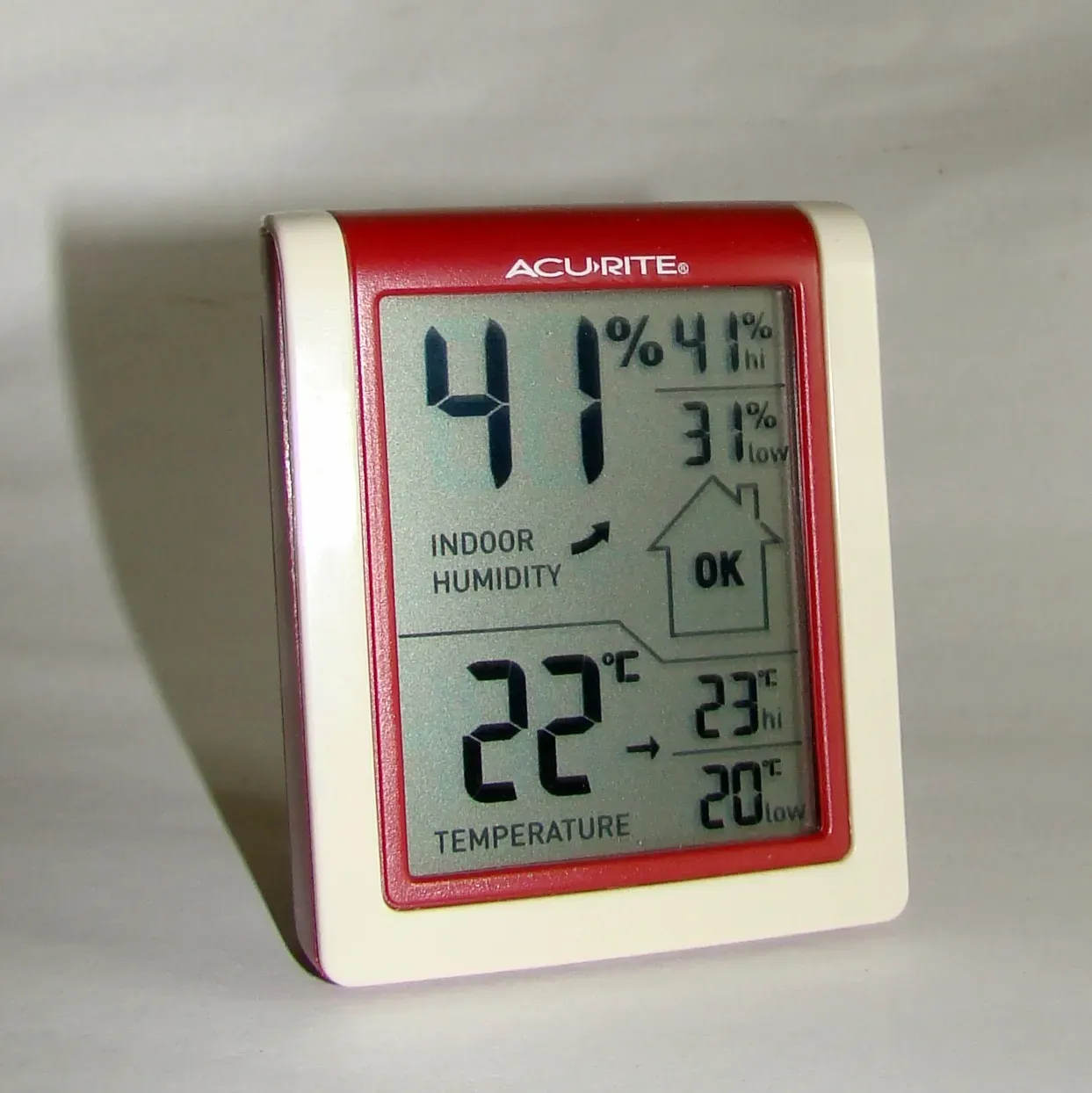
- A digital hygrometer reading 41% in a room: comfortable for people, but far too damp for an open spool of nylon or PETG.Photo: Pogrebnoj-Alexandroff ·CC BY 3.0 ·Wikimedia Commons
- A humidity indicator card from a sealed bag: each spot changes colour when the air passes its humidity level.Photo: Pemu ·CC0 ·Wikimedia Commons
Storing a bigger collection
Once you have more than a handful of spools, a little organisation saves a lot of drying.
- Sort by sensitivity. Keep nylon, PVA, PC and TPU in their own small, tightly sealed boxes or vacuum bags. PLA can share a big tub.
- Write the date on the bag when you open a spool and when you last dried it.
- Use the oldest open spool first.
- Keep new, sealed spools sealed. A factory-sealed bag with its desiccant is about as good as storage gets. Don’t open spools before you need them.
- Keep the cardboard boxes. A boxed spool, bagged with desiccant, stacks neatly and is protected from light and dust.
- Mind the spools themselves. Cardboard spools are common now; they work in any of the containers above but can shed fibres and dust, so keep them clean and away from the printer’s filament path.
- Refill coils (filament sold without a spool) store just like spools: bagged or boxed, with desiccant. Load them onto your reusable spool only when you’re ready to print.
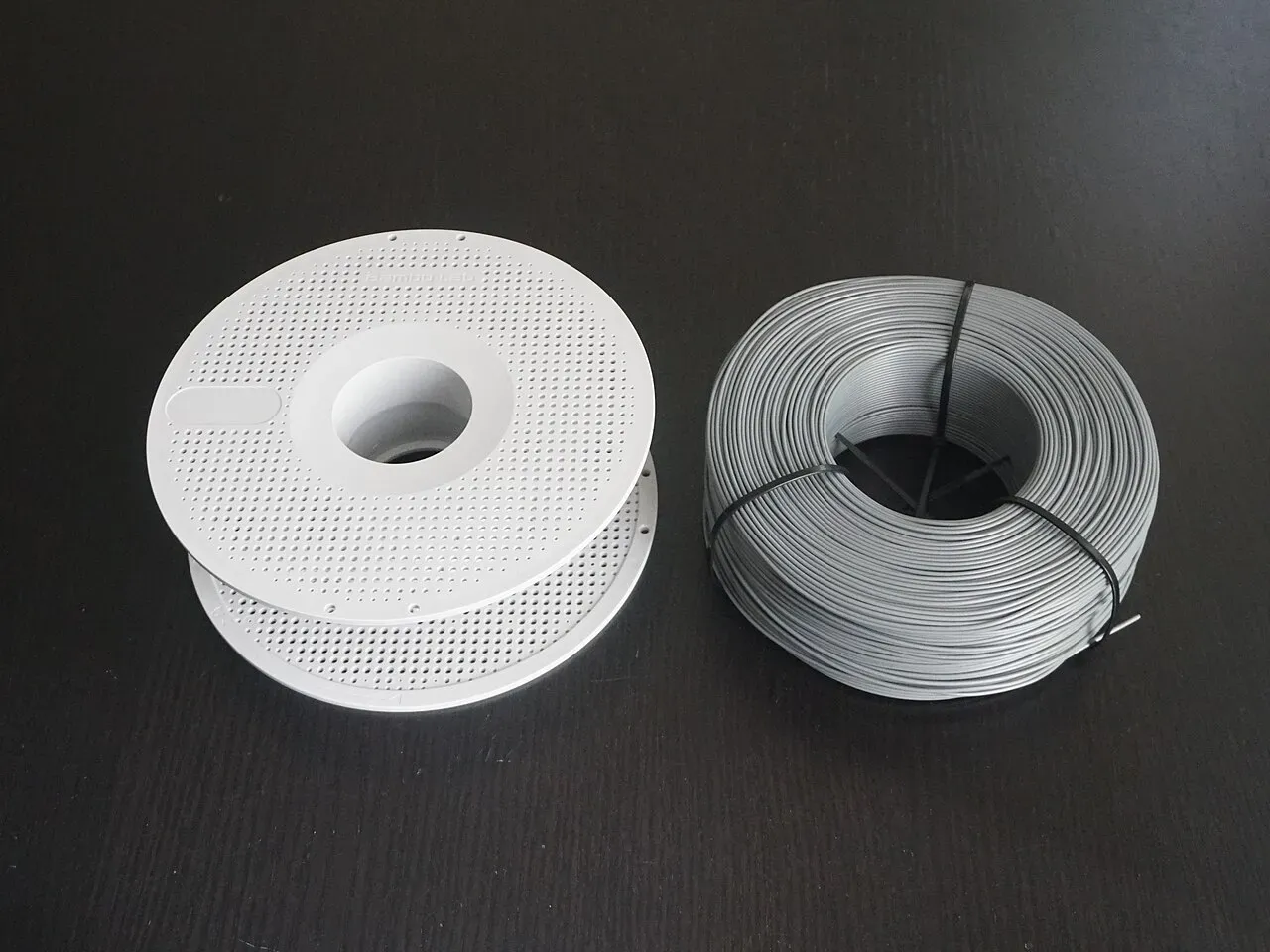 Refill filament: a coil and a reusable spool.Photo: Suit ·CC BY-SA 4.0 ·Wikimedia Commons
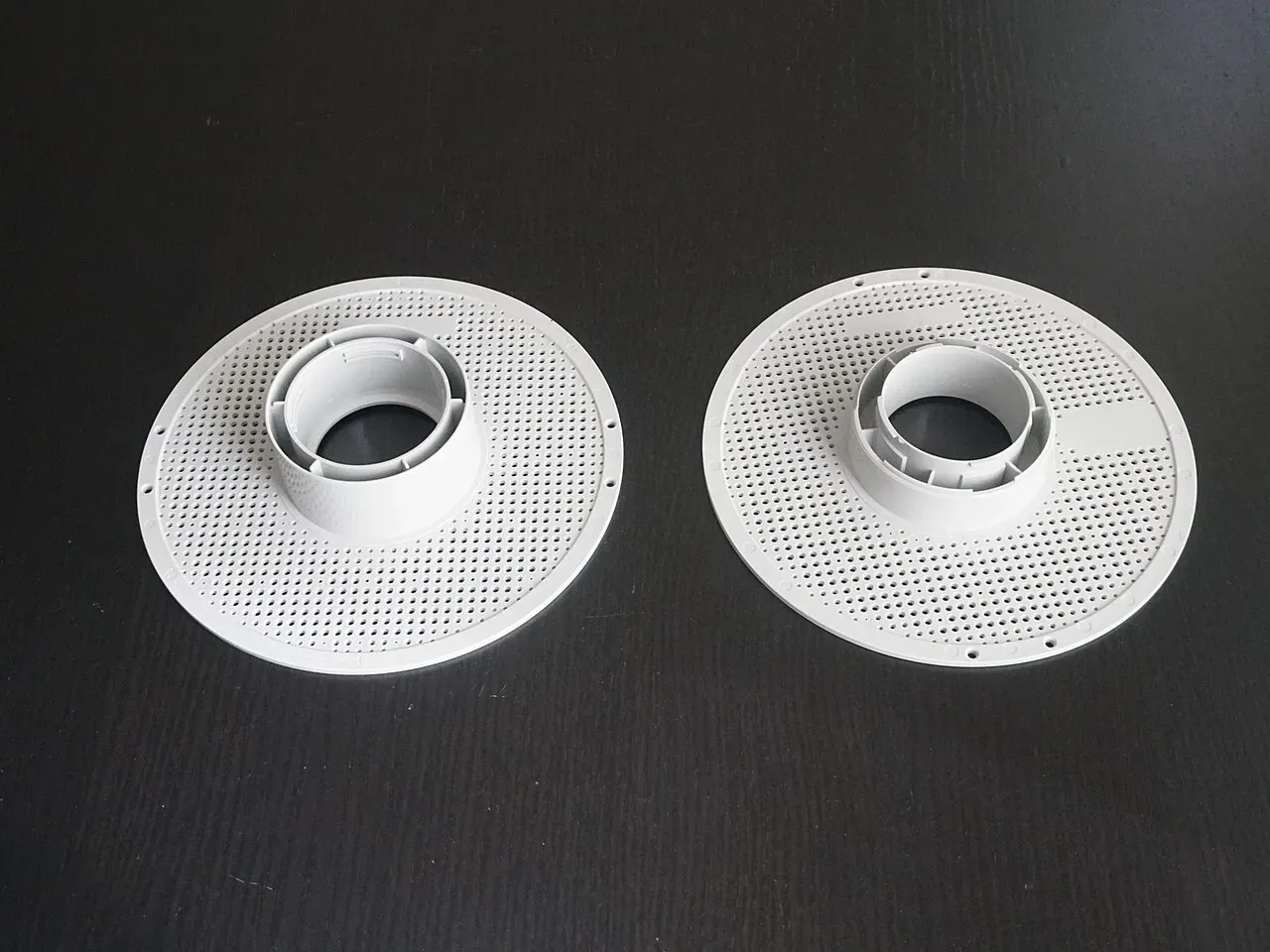 Open the reusable spool…Photo: Suit ·CC BY-SA 4.0 ·Wikimedia Commons
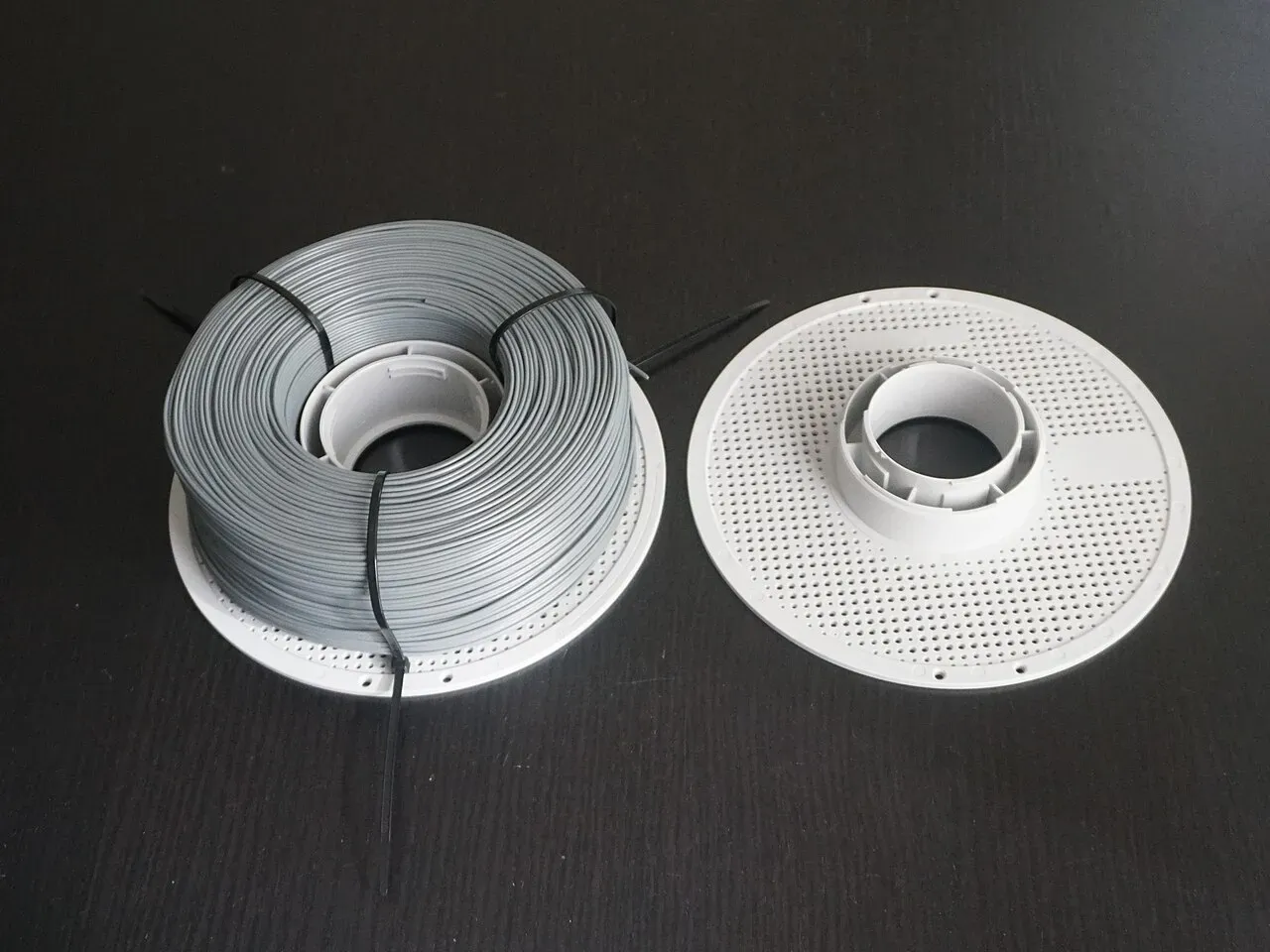 …drop the coil in…Photo: Suit ·CC BY-SA 4.0 ·Wikimedia Commons
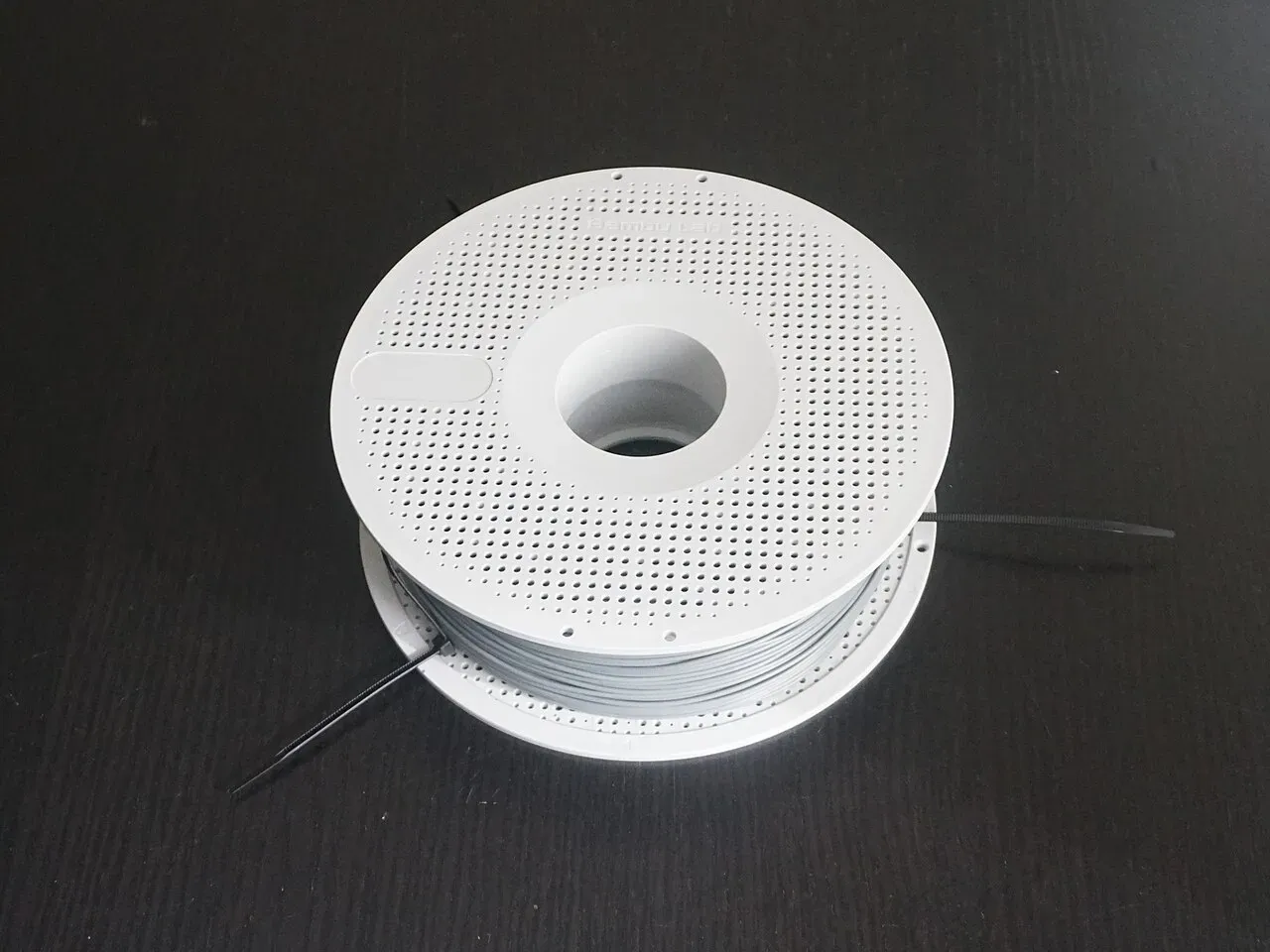 …and close it. Cut the ties last.Photo: Suit ·CC BY-SA 4.0 ·Wikimedia Commons
Where to keep your storage boxes
Even the best box does better in a good spot.
| Place | Good or bad | Why |
|---|---|---|
| A cupboard or shelf in a living room or spare room | Good | Stable temperature, out of the sun |
| Under a bed or in a wardrobe | Good | Dark and stable, if the room isn’t damp |
| A sunny windowsill | Bad | Heat can soften PLA; UV fades colours |
| Next to a radiator, heater or the printer’s exhaust | Bad | Heat, and temperature swings that make boxes “breathe” |
| A loft or attic | Usually bad | Very hot in summer, cold in winter |
| An unheated garage or shed | Usually bad | Damp air, large temperature swings, condensation |
| A basement | Depends | Often damp; fine if sealed boxes stay dry and it doesn’t flood |
| A car | Bad | Can get hot enough to soften PLA and PETG |
- Filament comes in almost every colour.Photo: westonhighschool library ·CC BY-SA 2.0 ·Wikimedia Commons
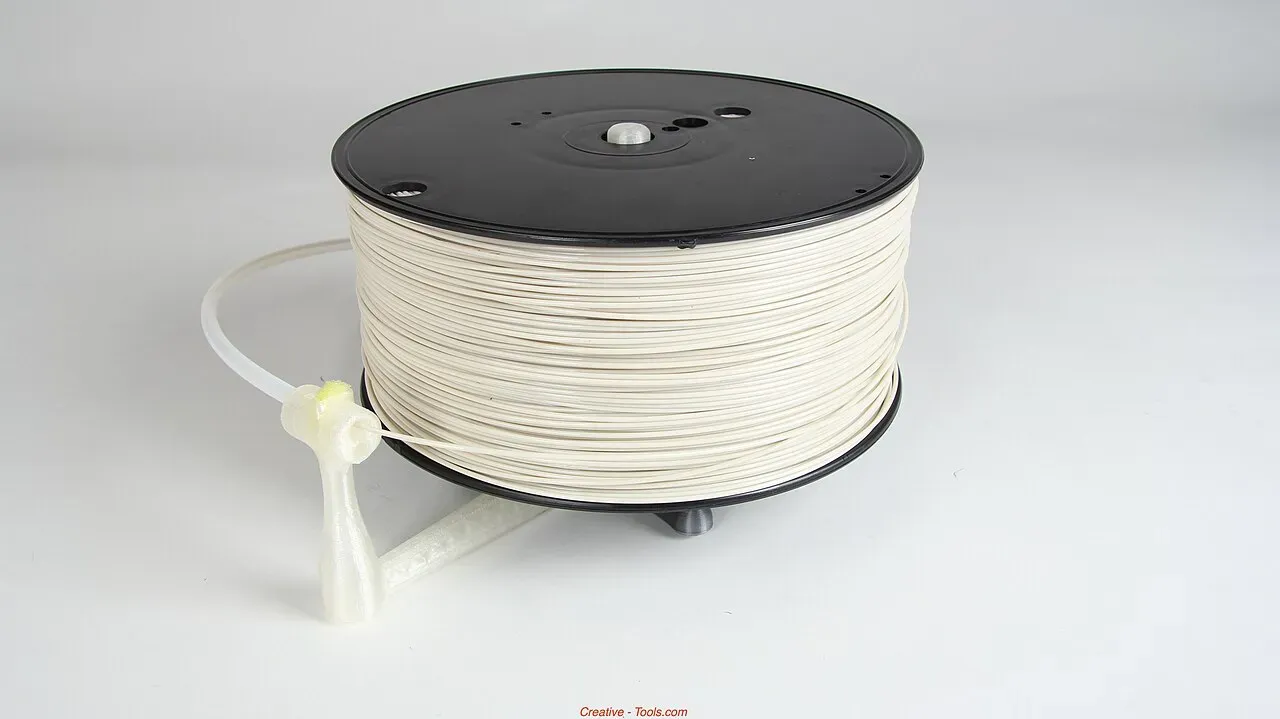 A spool of white filament.Photo: Creative Tools ·CC BY 2.0 ·Wikimedia Commons
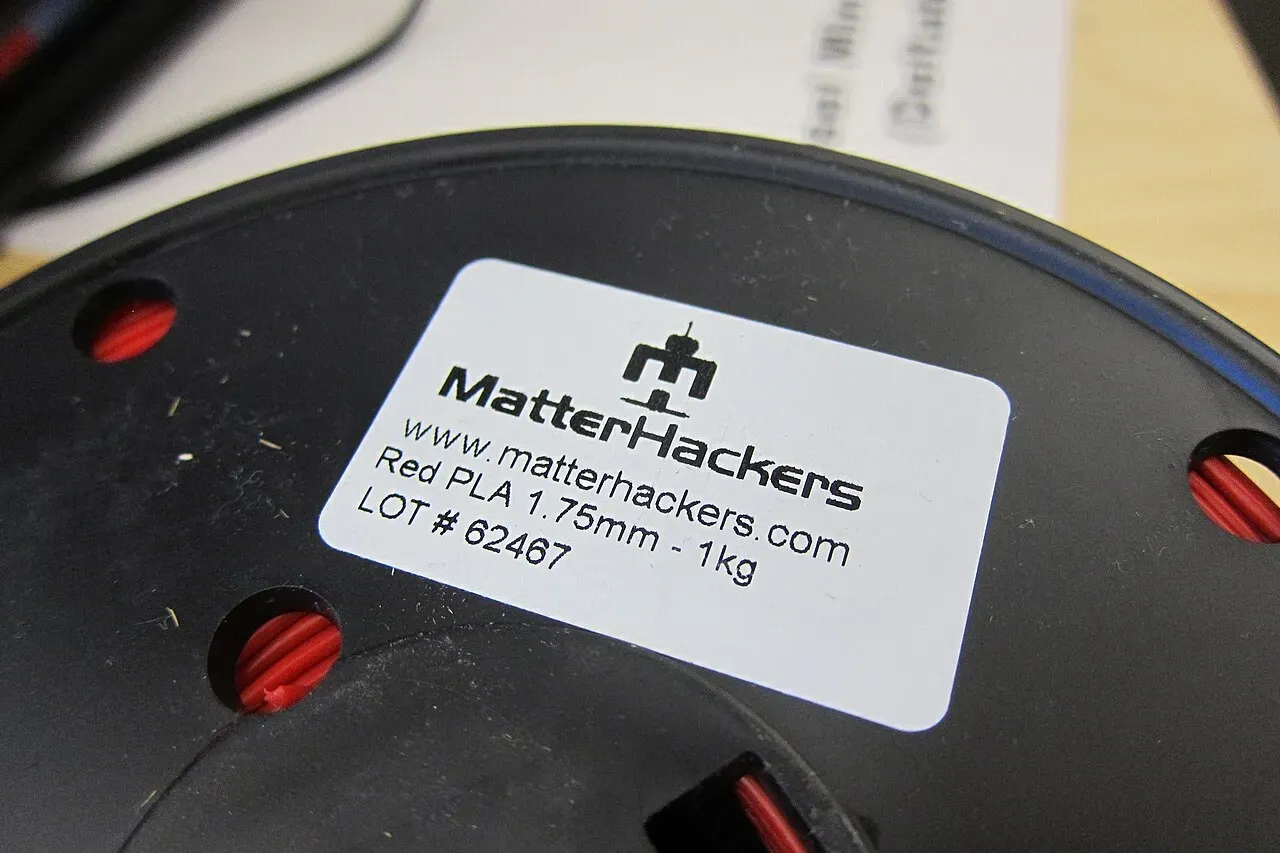 Read the label: material, 1.75 mm diameter, 1 kg.Photo: John Abella from Outside Philadelphia, USA ·CC BY 2.0 ·Wikimedia Commons
Look after the filament itself
Keep the end clipped
Every spool has small holes or slots in its rim for the free end. Use them every time you take a spool off the printer. If the end springs loose, the outer coils can loosen and jump over each other, making a crossed loop. When the printer later pulls on it, the loop tightens into a knot, and the extruder grinds or clicks until the print fails.
Don’t let it get brittle
PLA left out tends to turn brittle and snap, either on the spool or in the tube between the spool and the extruder. Moisture is widely blamed, though age and the tight curl near the spool’s core play a part too. Sealed, dry storage is the best way to avoid it, and drying sometimes brings brittle PLA back, but not always.
Keep it clean
Dust and pet hair stick to filament, especially in a dry, static-prone box, and go straight into the nozzle. Keep lids closed, and if a spool has been out, wipe the filament with a clean, dry cloth as it feeds, or use a small filament dust filter on the way into the extruder. A build-up of debris is one cause of the partial clogs covered in how to unclog a nozzle.
Dry first, then store
Storage keeps dry filament dry; it doesn’t dry wet filament. A box full of fresh desiccant will slowly pull a little water out of a damp spool, but far more slowly than a dryer.
So before a spool goes into long-term storage:
- Check it. If it pops, crackles or strings more than it used to, dry it first.
- Dry it at the right temperature for the material. The short version, from our full drying guide:
| Material | Drying temperature | Drying time |
|---|---|---|
| PLA | 45–50 °C | 4–6 hours |
| PETG | 60–65 °C | 4–6 hours |
| ABS / ASA | 60–80 °C | 4–6 hours |
| TPU | 50–65 °C | 4–8 hours |
| Nylon | 70–80 °C | 8–12 hours or more |
- Bag or box it straight away, while it’s still warm, with fresh desiccant. Its hygrometer will read low at first and rise a little as the box cools; that’s normal.
Use the filament maker’s drying temperature if it gives one; it can differ from these ranges.
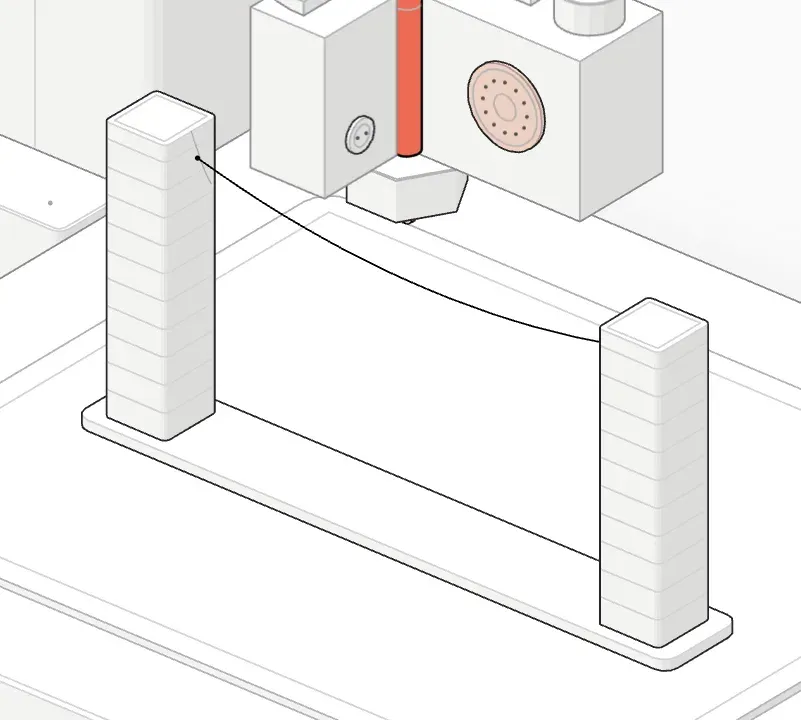 195 °C, 0.8 mm retraction: few strings.
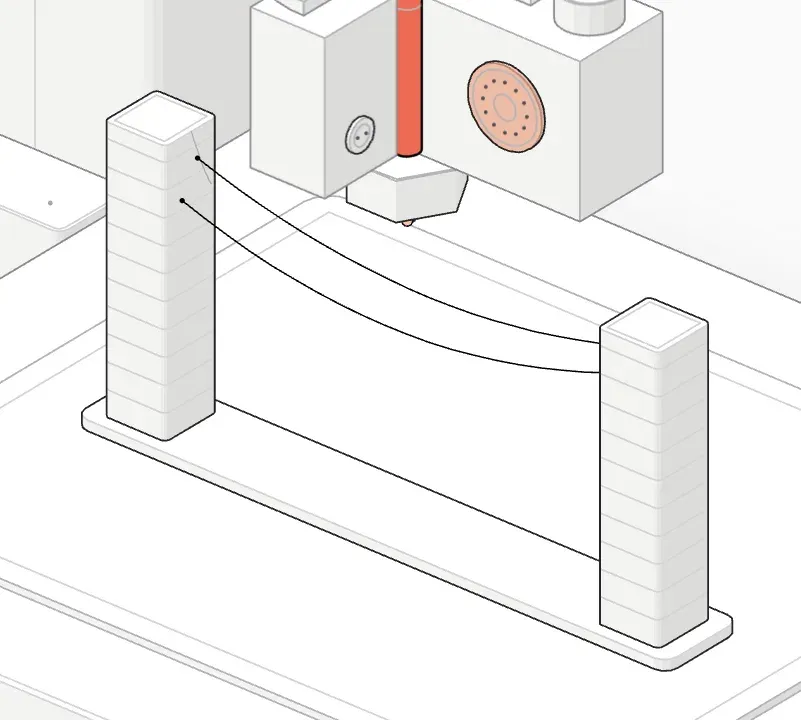 210 °C, 0.8 mm retraction: few strings.
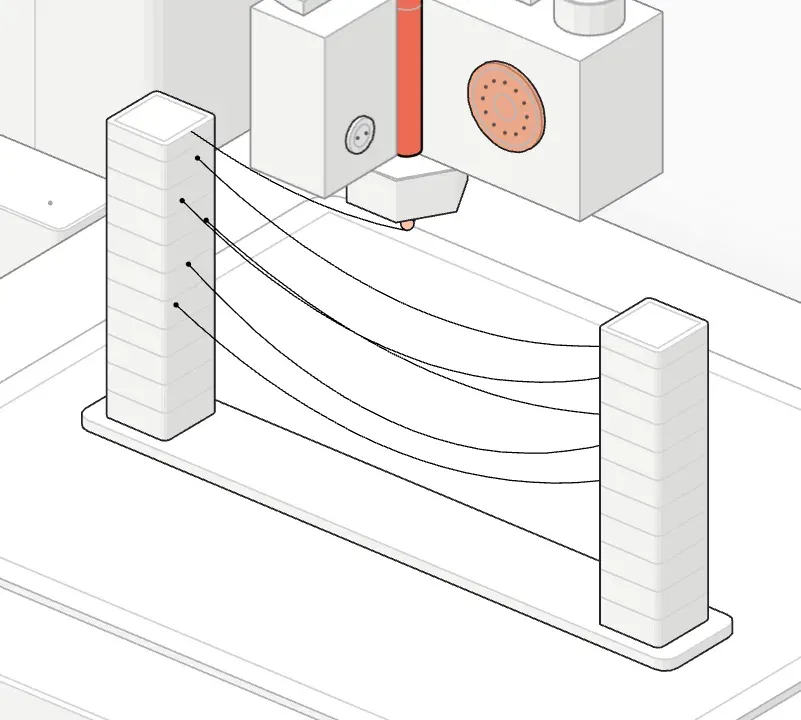 225 °C, 0.8 mm retraction: many strings.
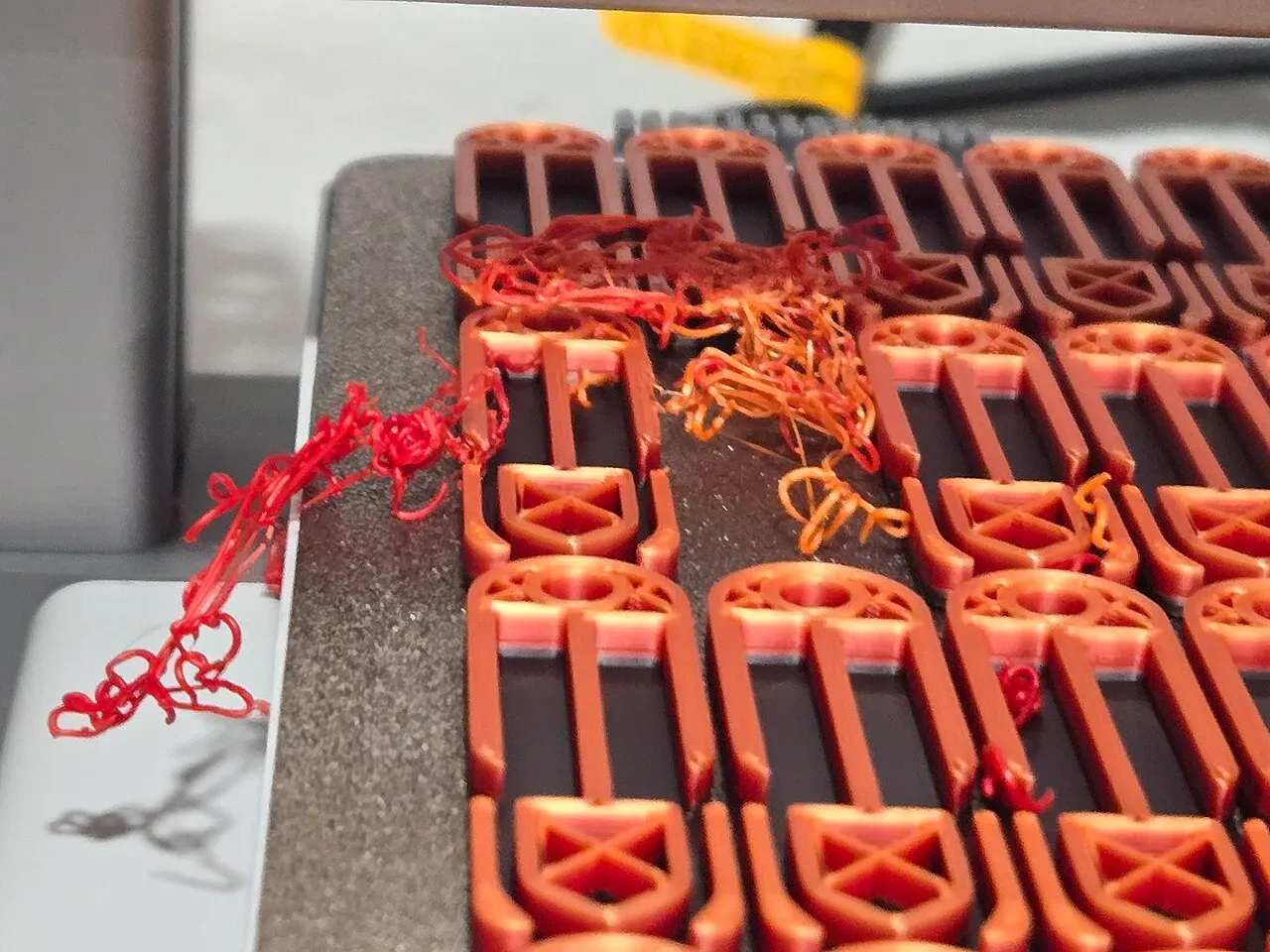 Strings and blobs across a full plate of parts.Photo: Quinn Daedal ·CC BY-SA 4.0 ·Wikimedia Commons
Common storage mistakes
- Storing a wet spool. It stays wet. Dry it, then store it.
- Trusting the tiny packet. The sachet in a new spool’s bag was sized for a sealed bag, not a box you open every day.
- A box without a gasket. Clip-on lids feel tight but let air in all the time.
- Desiccant that’s already full. Orange beads gone green, or blue beads gone pink, do nothing. Recharge them.
- No hygrometer. Without one you only find out the box failed when the print does.
- Leaving the spool on the printer between prints. Hours or days on an open holder add up, especially for PETG and TPU.
- Leaky dry-box fittings. A filament outlet without a seal around it is a hole in the lid.
- Storing in the garage or loft. Damp air and temperature swings work against even good boxes.
- Letting the free end go. One loose end can turn into a tangle that stops a print hours in.
When prints are still bad after good storage
If your spools sit below their target humidity and prints still pop, string or look rough, look beyond storage:
| Symptom | If storage is good, check… | Go here |
|---|---|---|
| Stringing on every spool, even fresh ones | Nozzle temperature and retraction | How to fix stringing |
| Gaps, thin walls, weak layers | Partial clog, drag on the spool or tube, nozzle too cool | Under-extrusion |
| Extruder clicking | Clog, heat creep, nozzle too close to the bed | Extruder clicking |
| Blobs and zits on the surface | Seam, retraction and pressure settings | Blobs and zits |
| Rough surface on one brand only | That spool’s best temperature | Temperature tower |
| Brittle PLA that snaps even after drying | Age or a tightly wound core | Try a fresh spool |
The quickest test is still a swap: load a fresh, factory-sealed spool of the same material. If the problem goes away, the old spool needs drying. If it doesn’t, the problem was never moisture.
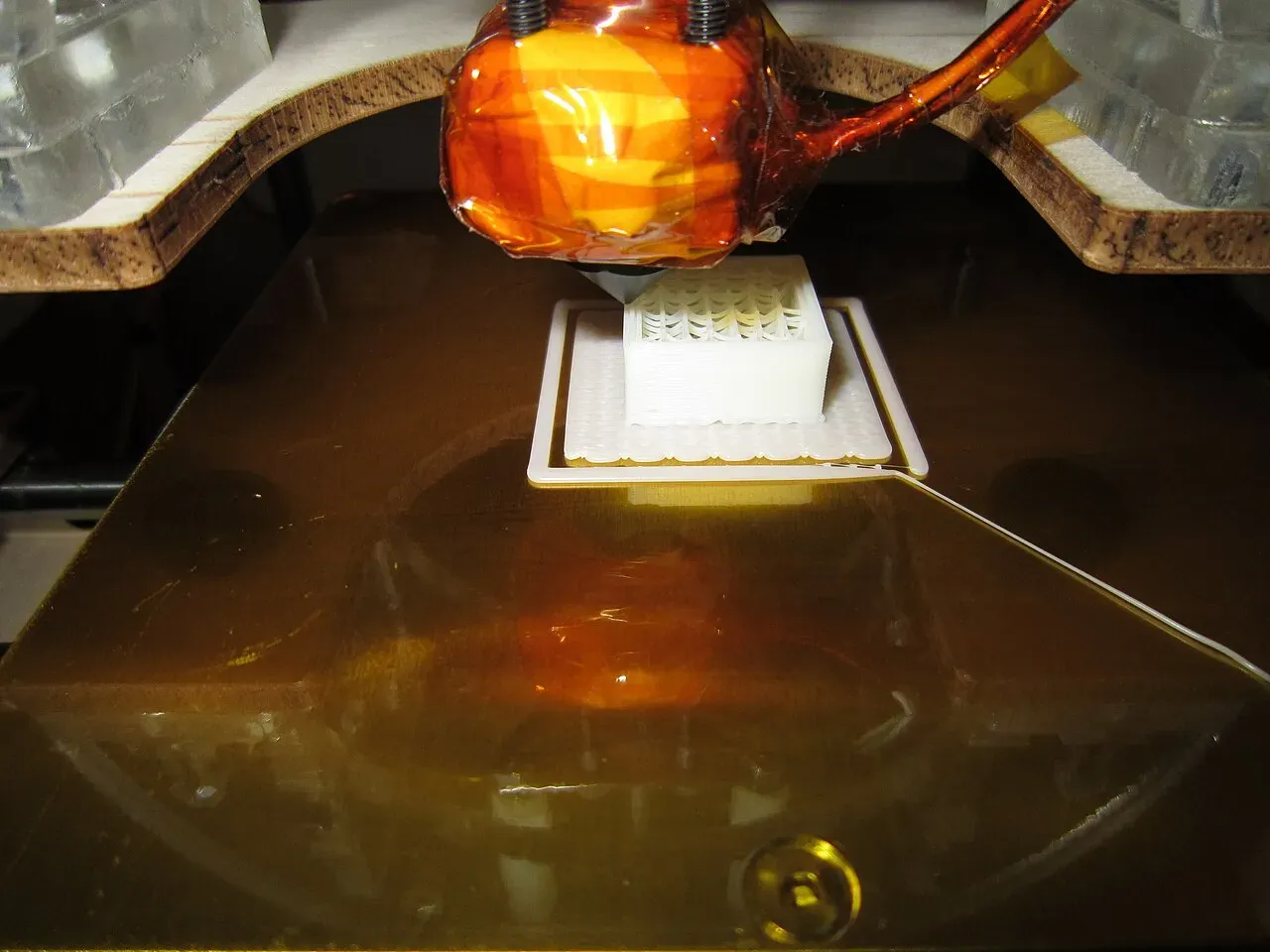 A 20 mm calibration cube, often the first print.Photo: syvwlch ·CC BY 2.0 ·Wikimedia Commons
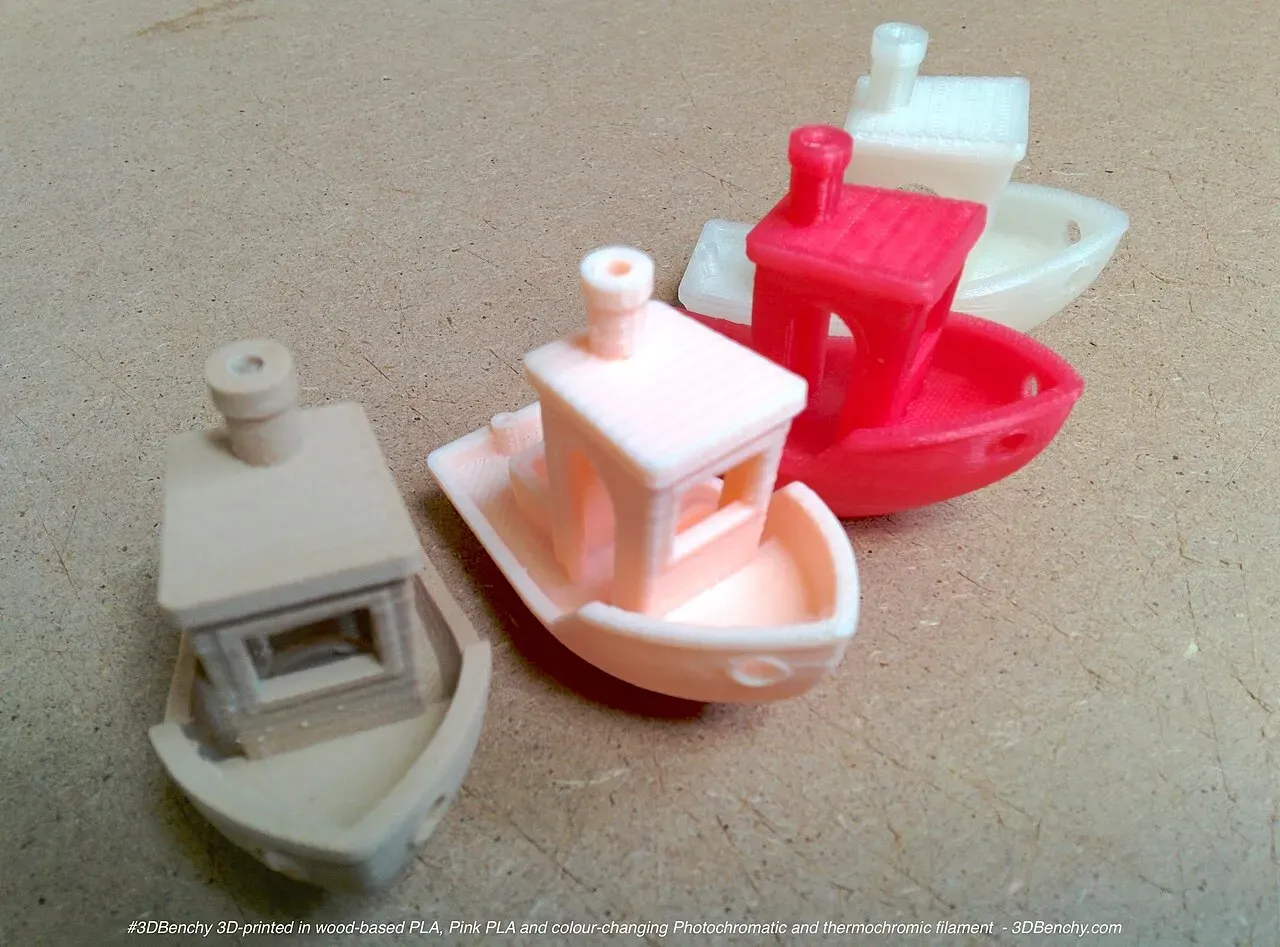 Printed Benchys in different filaments.Photo: 3DBenchy ·CC BY 2.0 ·Wikimedia Commons
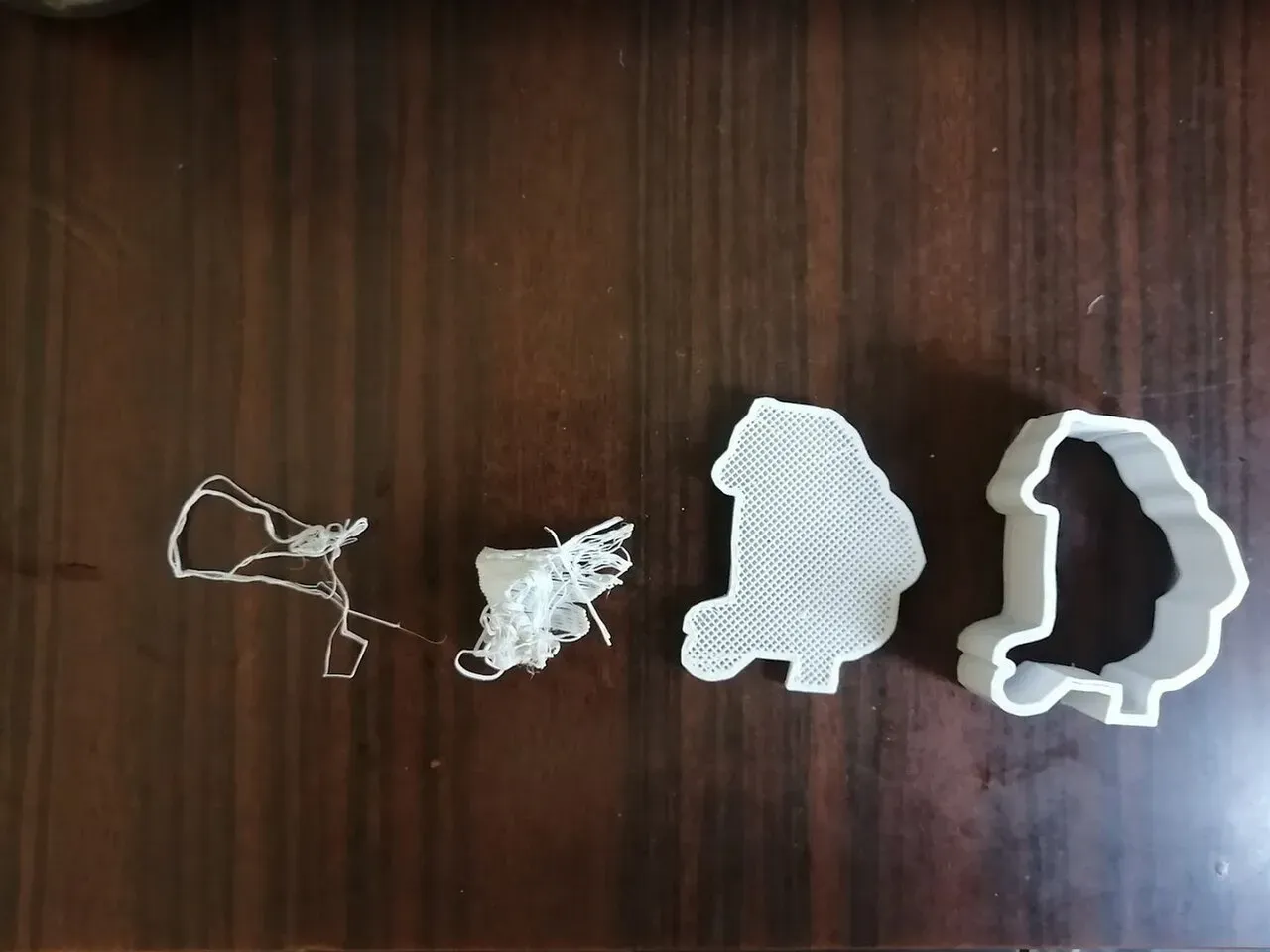 Test prints on the way from failure to a clean part.Photo: Dbsnp ·CC BY-SA 4.0 ·Wikimedia Commons
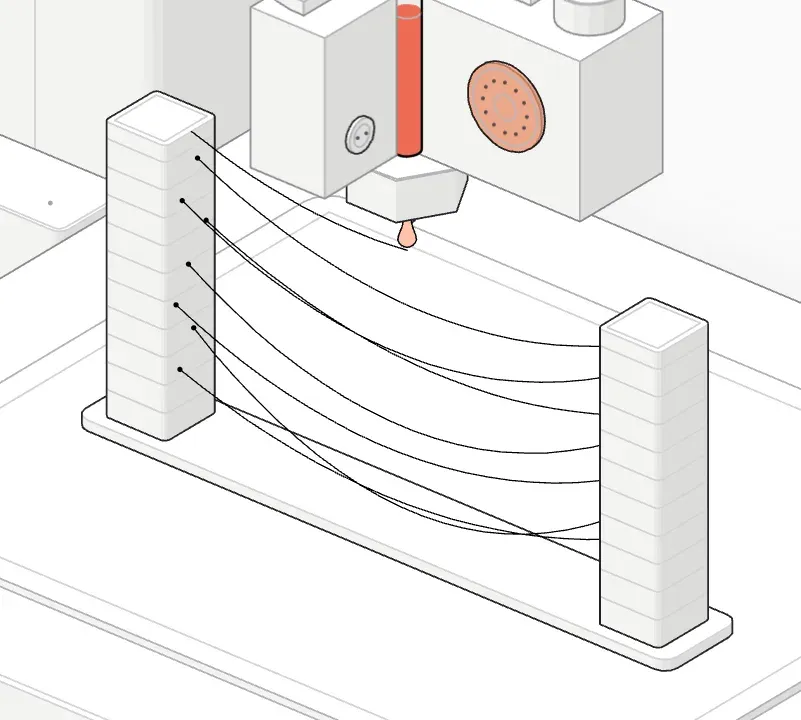 225 °C · 0.0 mm: many strings.
- 225 °C · 0.8 mm: many strings.
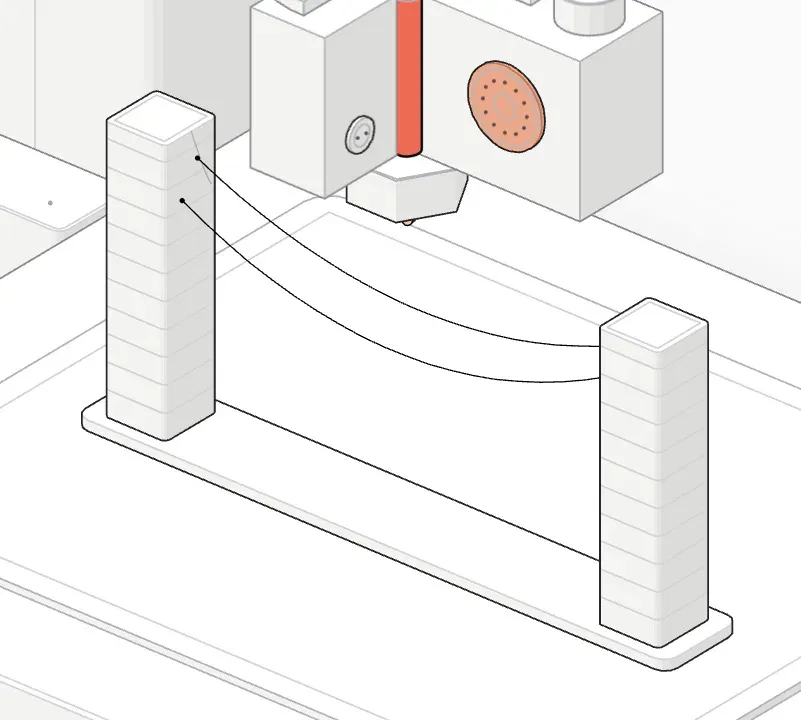 225 °C · 1.6 mm: few strings.
Your action plan
- Put every open spool in a sealed bag, vacuum bag or gasketed box with plenty of colour-changing silica gel.
- Add a hygrometer to each box.
- Keep PETG, TPU, nylon, PC and PVA below about 20%; PLA, ABS and ASA below about 30%.
- Dry any spool that pops or strings before storing it.
- Recharge the desiccant when the hygrometer rises or the beads change colour.
- Keep the boxes somewhere cool, dark and stable.
- Clip the free end every time.
- Print the thirstiest materials straight from a dry box or a filament dryer.
FAQ
What’s the best way to store 3D printer filament?
In an airtight container, such as a box with a gasketed lid or a vacuum bag, with colour-changing silica gel desiccant and a hygrometer inside, kept somewhere cool and out of the sun. Aim for below about 20% humidity for PETG, TPU and nylon, and below about 30% for PLA.
What humidity should filament be stored at?
Below about 20% relative humidity for moisture-sensitive materials such as PETG, TPU, nylon, PC and PVA, and below about 30% for PLA, ABS and ASA. Lower is better for nylon and PVA. A normal home sits around 30–60%, which is why open spools keep absorbing water.
How long can filament sit out before it gets wet?
It depends on the material and the room. In a humid room, nylon and PVA can print badly after hours to a day or two; TPU and PETG within days to weeks; PLA usually takes weeks to months. Store anything you’re not printing with, and don’t count on the clock: watch for popping and stringing.
Do vacuum bags keep filament dry?
Yes, if you add desiccant and the bag holds its vacuum. The vacuum leaves very little air, and so very little water, around the spool. Check the bag the next day: if it has gone slack, it’s leaking. A vacuum bag won’t dry a spool that’s already wet.
Is the desiccant packet that comes with the filament enough?
For the sealed factory bag, yes. Once you open it, usually not: the packet is small and fills up quickly in a box you open often. Add more desiccant, ideally indicating silica gel you can see changing colour.
How do I know when my desiccant needs recharging?
Indicating silica gel changes colour: orange beads turn green or pale, blue ones turn pink. A hygrometer is the better guide: recharge when a PETG, TPU or nylon box creeps above about 20%, or a PLA box above about 30%.
How do I recharge silica gel?
Spread the beads on a metal or glass tray and heat them at the temperature on the packet, commonly around 100–120 °C for about 2 hours, until they return to their dry colour. Don’t exceed the packet’s temperature, or the colour indicator can stop working. Cool them in a sealed jar before reusing.
Does PLA need to be stored in a dry box?
It needs to be stored sealed, but it’s the least fussy common filament. A good zip bag or box with some desiccant is usually enough. You rarely need to print PLA from a dry box unless your room is very humid.
Can I store filament in the garage?
It’s not ideal. Garages are often damp and swing between warm and cold, which works against sealed boxes and can cause condensation when you bring a cold spool indoors. If you must, use sealed boxes with plenty of desiccant, and let spools warm up before opening them.
Is an enclosed printer a good place to keep filament?
No. An enclosure keeps the print warm; it doesn’t keep air dry. Spools stored inside or on top of an enclosed printer sit in warm room air. Use a sealed box or dry box beside the printer instead.
Related guides
If a spool is already wet, start with how to dry filament. To choose the right material in the first place, read the 3D printing filament guide, PLA vs PETG and PLA vs ABS. If prints still string after the spool is dry, work through how to fix stringing, and for gaps and clicking see under-extrusion and extruder clicking. New to all of this? Begin with the complete beginner’s guide.
Free: the Print Problems Cheat Sheet
12 common print faults on two printable pages: what each looks like, why it happens and the fix. Plus one new guide a week.
Free: the Print Problems Cheat Sheet
12 common print faults on two printable pages: what each looks like, why it happens and the fix. Plus one new guide a week.